


Your hoverboard battery drains quickly due to factors like battery age, rough terrain, heavy weight loads, and improper charging habits. By adjusting how you ride, store, and charge your board, you can easily boost its battery life. This guide will help you find the cause and fix it fast.
Imagine this. You step onto your hoverboard on a sunny day. You are ready for a fun ride. You glide down the sidewalk. Suddenly, you hear a loud beep. The battery light flashes red. Your board slows to a stop. You have only been riding for ten minutes! It is a huge disappointment. Your fun ride is over before it really started.
This is a very common issue. Many riders ask themselves, “Why Does My Hoverboard Battery Drain So Fast?” It can make your cool gadget feel useless. But do not worry. You do not have to buy a new hoverboard just yet. There are many reasons why this happens, and most of them are easy to fix.
In this guide, we will look at the main reasons for this issue. We will cover battery health, riding habits, and simple ways to fix it. Let us dive in and get you back to riding longer.
Key Takeaways
- Battery Age: Lithium-ion batteries lose capacity naturally over time and need replacement after 1 to 2 years.
- Terrain Impact: Riding on grass, gravel, or steep hills drains the battery much faster than smooth pavement.
- Weight Limits: Carrying heavier loads forces the motor to draw more power, reducing ride time.
- Smart Charging: Overcharging your board or using cheap chargers can ruin the battery cells.
- Weather Effects: Extreme cold and high heat slow down battery performance and reduce range.
- Tire Care: Low tire pressure increases drag and wastes valuable battery energy.
📑 Table of Contents
1. The Natural Aging of Your Battery
All batteries get old. Most hoverboards use lithium-ion batteries. These batteries are great because they hold a lot of power. They are also lightweight. But they do not last forever. Every time you charge and use your board, the battery loses a tiny bit of its health.
The Life Cycle of Lithium-Ion Cells
Inside your battery, chemical reactions create power. Over time, these chemicals wear out. After a year of regular use, you might notice a drop in performance. If you wonder, “Why Does My Hoverboard Battery Drain So Fast?”, the age of your battery is often the main suspect. A battery that is two years old will not last as long as a brand-new one. This is just how the technology works.
Signs Your Battery Is Wearing Out
How do you know if your battery is dying? First, look at the charge time. Does it charge in just thirty minutes instead of hours? That is a bad sign. It means the battery can no longer hold a full charge. Second, does the board die suddenly without warning? If yes, it is likely time to buy a replacement battery. Always look for high-quality replacements to stay safe.
2. How Your Riding Habits Impact Power
Your riding style plays a huge role in battery life. Just like a car, how you drive affects your fuel. For a hoverboard, your “fuel” is electricity. If you ride hard, you will use more power. It is that simple.
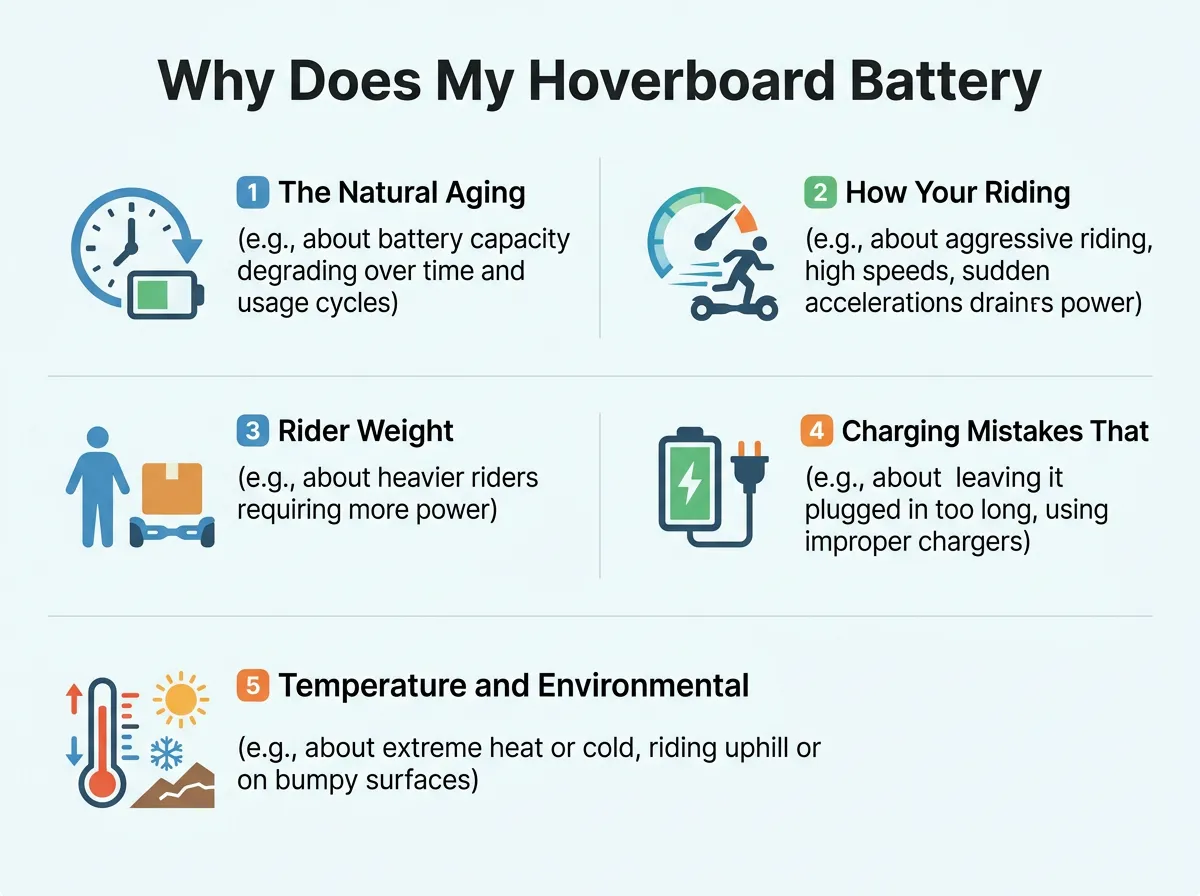
Why Does My Hoverboard Battery Drain So Fast? — key points at a glance
Riding on Rough Surfaces
Where do you ride your hoverboard? Smooth pavement is best. If you ride on grass, gravel, or thick carpet, your motor has to work much harder. This extra work drains the battery very quickly. If you ask, “Why Does My Hoverboard Battery Drain So Fast?”, check your riding terrain. Stick to flat, smooth paths to save your battery power.
Hills and Steep Inclines
Going uphill takes a lot of energy. If you live in a hilly area, your battery will drain fast. The motors have to fight gravity to push you up. To save battery, try to avoid steep hills. Walk your board up big hills instead of riding it. Your battery will thank you for the break.
Speed and Stop-and-Go Riding
Do you like to ride at top speed? Riding fast uses more energy. Also, stopping and starting constantly is bad for the battery. It takes more power to start moving than to keep moving. Try to ride at a steady, moderate speed. This helps you get the most range out of a single charge.
3. Rider Weight and Load Limits
Every hoverboard has a weight limit. This limit is very important for battery life. Carrying too much weight puts a strain on the entire system.
How Weight Affects Power Draw
More weight means the motors must work harder to balance and move you. If you are close to the maximum weight limit, your battery will drain faster. Carrying a heavy backpack can also add to this strain. If you keep asking, “Why Does My Hoverboard Battery Drain So Fast?”, consider the weight on the board. Even small additions can make a difference.
Finding Your Board’s Sweet Spot
Check your owner’s manual. Look for the weight limit. If you want the best battery life, try to stay well below this limit. Light riders will always get more riding time than heavier riders. If you are sharing the board, keep this in mind.
4. Charging Mistakes That Ruin Batteries
How you charge your board matters a lot. Many people make simple mistakes that ruin their batteries over time. Proper charging is the key to battery longevity.
The Danger of Overcharging
Do you leave your hoverboard plugged in overnight? This is a big mistake. Overcharging can overheat the battery. It damages the cells and reduces their life. Always unplug the charger as soon as the green light turns on. Do not leave it connected to the wall for days.
Using the Wrong Charger
Always use the charger that came with your board. Cheap, generic chargers from the internet can be dangerous. They may deliver too much or too little voltage. This can answer the question, “Why Does My Hoverboard Battery Drain So Fast?” A bad charger can slowly kill your battery health. It can even be a safety hazard.
5. Temperature and Environmental Issues
Hoverboards do not like extreme weather. Temperature has a direct effect on chemical reactions inside the battery. You should always be mindful of where you ride and store your board.
The Impact of Extreme Cold
Lithium-ion batteries hate the cold. If you ride in freezing temperatures, the chemical reactions slow down. The battery cannot release energy easily. This makes it drain very quickly. Avoid riding outdoors during cold winter days. Store your board inside where it is warm.
High Heat and Sun Exposure
Hot weather is also bad. High heat can cause the battery to overheat. This can be dangerous and cause permanent damage. Never leave your hoverboard in a hot car trunk. Store it in a cool, dry place inside your home. Keeping it at room temperature is best.
6. Simple Tips to Make Your Battery Last Longer
Now you know the causes. Let us look at some easy solutions. You can make your battery last much longer with a few simple changes.
Keep Your Tires Pumped
If your hoverboard has air-filled tires, check them often. Low tire pressure creates drag. This forces the motor to use more power. Keep them pumped to the right pressure. If you have solid tires, keep them clean. Dirt and hair can get stuck in the wheels and cause friction.
Calibrate Your Hoverboard
Sometimes, the board just needs a reset. A poorly calibrated board can waste energy trying to stay balanced. Turn off your board. Place it on a flat surface. Hold the power button for ten seconds until the lights flash. Turn it off and then back on. This simple trick can help save battery life.
Store the Battery Correctly
Are you putting your board away for the winter? Do not store it with a dead battery. Also, do not store it fully charged. Keep it at about fifty percent charge. This is the healthiest state for a lithium-ion battery in storage. Check on it and charge it once a month.
Conclusion
A fast-draining battery can be very annoying. But now you know the answer to, “Why Does My Hoverboard Battery Drain So Fast?” Keep an eye on your riding habits. Charge your board safely. Keep it away from extreme weather. By following these simple steps, you can enjoy long, fun rides once again. Take care of your board, and it will take care of you. Happy riding!
Frequently Asked Questions
How long should a hoverboard battery last on a single charge?
A typical hoverboard battery should last between 45 minutes to 2 hours of continuous riding. This depends greatly on your speed, rider weight, and the terrain. Older batteries will have a shorter run time.
Can I leave my hoverboard charging overnight?
No, you should never leave your hoverboard charging overnight. Overcharging can overheat the battery and damage its cells, which reduces its overall life. Always unplug the charger once the indicator light turns green.
Why does my hoverboard die when the battery indicator says it is full?
This usually happens because of a damaged or degraded battery cell that cannot handle a load. While the voltage looks correct when idle, it drops instantly when you stand on the board. You likely need a replacement battery.
Does riding fast drain the battery quicker?
Yes, riding at maximum speed forces the motors to draw more electrical current from the battery. To get the maximum range out of your hoverboard, try to ride at a moderate and steady pace.
How do I know if my hoverboard battery is bad?
Your battery is likely bad if it charges too quickly, loses charge within minutes of riding, or causes the board to shut down randomly. If the board only works when plugged into the charger, the battery must be replaced.
Can cold weather affect my hoverboard battery?
Yes, cold temperatures slow down the chemical reactions inside lithium-ion batteries. This reduces their capacity and causes the battery to drain much faster. It is best to ride and store your hoverboard in room-temperature conditions.
