


Learning how to ride a hoverboard is easy when you follow the right steps. Start by wearing safety gear, step on with one foot at a time, and keep your body upright. To move, simply lean slightly in the direction you want to go and practice on flat, smooth surfaces.
Picture this: you are walking through the park on a sunny afternoon. Suddenly, someone zooms past you. They are gliding effortlessly on a self-balancing scooter, looking like they stepped straight out of a sci-fi movie. It looks incredibly fun, and you find yourself wanting to try it. But when you look at that two-wheeled machine, you might feel a little nervous. How do you stay upright? Is it easy to fall?
If you are asking yourself how to use a hoverboard, you are not alone. These futuristic gadgets can look intimidating at first. However, learning to ride one is much easier than it looks. With a little patience, some basic safety tips, and the right technique, you can master your board in less than thirty minutes. Knowing how to use a hoverboard safely will make your experience much more enjoyable.
In this guide, we will break down everything you need to know. We will cover the gear you need, how to step on and off without falling, how to steer, and how to stay safe. By the time you finish reading, you will have all the confidence you need to jump on your board and start gliding.
Key Takeaways
- Gear Up First: Always wear a helmet, wrist guards, elbow pads, and knee pads before riding.
- Step On Confidently: Place your dominant foot on the board first, then quickly and smoothly bring up your other foot.
- Control with Lean: Lean forward slightly to move ahead, lean back to reverse or slow down, and shift weight to turn.
- Look Straight Ahead: Keep your eyes looking forward rather than down at your feet to maintain balance.
- Step Off Backward: Always step off the back of the hoverboard one foot at a time to avoid tripping.
- Calibrate Regularly: If your board shakes or feels off-balance, calibrate it according to the manual.
📑 Table of Contents
Choosing the Right Spot to Learn
Before you even turn on your hoverboard, you need to find the perfect practice space. Your learning environment plays a huge role in how quickly you pick up this new skill. Having a clean space makes learning how to use a hoverboard much faster.
Start Indoors or on Smooth Concrete
When you are first learning how to use a hoverboard, you want to avoid rough ground. Look for a flat, smooth, and hard surface. A spacious living room with hardwood floors or thin carpet is a great place to start. If you want to practice outdoors, a flat concrete driveway or a quiet, paved basketball court works beautifully. Stay away from grass, gravel, and cracked pavements for now. These uneven surfaces can cause the board to shake and make balancing much harder.
Have a Spotter or Use a Support
Do not try to go at it alone on your first try. It is highly recommended to have a friend or family member stand in front of you as a spotter. You can hold onto their shoulders for balance as you get used to the feel of the board. If you do not have a helper, practice near a sturdy wall, a heavy table, or a strong railing. Having something secure to hold onto will prevent falls and boost your confidence.
Putting on the Essential Safety Gear
Safety should always come first. Hoverboards are fast, and falls can happen to anyone, especially beginners. Wearing the right gear will keep you safe and give you the peace of mind to learn without fear. Before we discuss how to use a hoverboard, let’s look at safety gear.
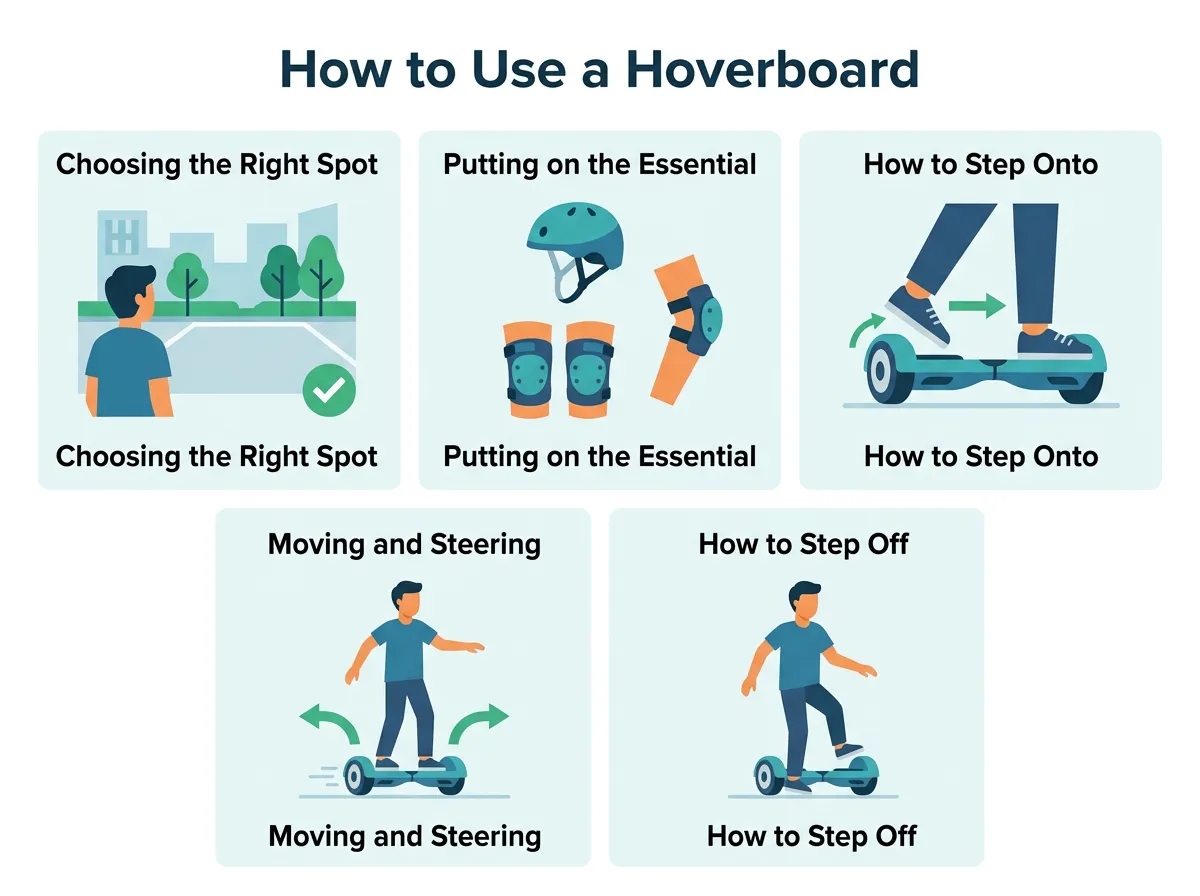
How to Use a Hoverboard? — key points at a glance
Why a Helmet is Non-Negotiable
Never step onto a hoverboard without a helmet. A standard skateboard or bicycle helmet is perfect. Your head is the most important part of your body to protect. Even a minor fall at a slow speed can lead to a head injury if you are not careful. Make sure your helmet fits snugly and is buckled securely under your chin.
Pads and Guards for Safe Falls
When people fall from a hoverboard, they naturally try to catch themselves with their hands. This makes wrist injuries very common. Wearing wrist guards is one of the smartest things you can do. Additionally, put on elbow pads and knee pads. If you do lose your balance, these pads will absorb the impact and save you from painful scrapes and bruises. Comfortable athletic shoes with flat soles are also a must. Avoid wearing sandals, flip-flops, or high heels.
How to Step Onto the Hoverboard Safely
Getting onto the board is often the scariest part for beginners. Once you understand the physical mechanics, it becomes a simple muscle memory task. Mastering how to use a hoverboard starts with a solid stance.
The Dominant Foot First Method
First, place your hoverboard on a flat surface directly in front of you. Turn the power button on. You should see the status lights turn green, indicating the board is active and ready to balance.
Start by placing your dominant foot onto the board. This is usually the foot you kick a soccer ball with. Place it flat against the outer edge of the footpad. Make sure your foot is straight and close to the wheel. This gives you maximum control and stability. If you want to know how to use a hoverboard without falling, you must focus on your foot placement.
Finding Your Center of Gravity
Now comes the key moment. Do not hesitate or wiggle your foot. Instead, quickly and smoothly step up with your other foot. Place it on the other side of the board, matching the position of your first foot.
Keep your feet wide and your knees slightly bent. Try to stand straight and look forward. A common mistake is looking down at your feet. Looking down shifts your head forward, which throws off your balance. Keep your eyes up, breathe normally, and let the hoverboard do its job. It is designed to balance itself, so let your body relax.
Moving and Steering Your Hoverboard
Once you are standing comfortably on the board, it is time to move. Hoverboards use smart sensors called gyroscopes. These sensors detect your weight shifts and tell the motors which way to turn the wheels. Once you know how to stand, learning how to use a hoverboard to travel is the next step.
Moving Forward and Backward with Micro-Leans
To move forward, do not bend your waist. Bending at the waist will make you fall. Instead, think about leaning your entire body slightly forward, almost like you are leaning on your toes. A very tiny shift in weight is all it takes. The board will respond instantly and move forward.
To slow down or stop, shift your weight back toward your heels. If you keep leaning back, the hoverboard will begin to roll backward. Think of these movements as micro-leans. The smaller and gentler your movements, the smoother your ride will be.
How to Turn Left and Right
Turning is incredibly intuitive. To turn, you simply press down with one foot more than the other. When you are figuring out how to use a hoverboard for steering, think of your feet as gas pedals.
If you want to turn right, push your left toes forward slightly. This tells the left wheel to spin faster, which swings the board to the right. If you want to turn left, push your right toes forward. It helps to think of it as pointing with your toes. Push down the toe on the side opposite of where you want to go.
Spinning in Circles
Once you get the hang of basic turns, you can try spinning. To spin in a tight circle, push down with the toes of one foot while pushing down with the heel of your other foot. For example, to spin clockwise, push your left toes forward and press your right heel backward. Practice this slowly at first until you get used to the spinning sensation.
How to Step Off Your Hoverboard
Knowing how to step off is just as important as knowing how to get on. Many beginners make the mistake of jumping off forward, which often leads to the board shooting backward and causing a fall. An important part of learning how to use a hoverboard is mastering the dismount.
Why You Must Step Off Backward
Always, without exception, step off backward. When you step off the back, your body weight naturally shifts away from the motion sensors. This keeps the board stable. If you try to step off forward, you will accidentally lean into the sensors, causing the board to accelerate forward beneath you.
The Step-by-Step Dismount
First, bring the hoverboard to a complete stop. Make sure you are not moving at all. Hold onto your spotter or support if you need to.
Shift all of your weight onto your non-dominant foot. Carefully lift your dominant foot and step straight back onto the ground. Once that foot is firmly on the ground, lift your other foot off the board and step back. Congratulations, you have successfully dismounted!
Pro Tips for Mastering Your Hoverboard
To help you progress from a nervous beginner to a confident rider, keep these simple tips in mind during your practice sessions. As you practice how to use a hoverboard, you might experience some minor shaking.
Calibrate Your Board Regularly
If your hoverboard feels shaky, vibrates, or pulls to one side, it might need to be calibrated. Calibration resets the internal sensors so the board knows what “flat” feels like. To calibrate, turn off the board. Place it on a completely level surface. Hold the power button down for about five to ten seconds until the lights flash. Turn the board off, then turn it back on. This simple fix solves most balance issues.
Avoid the “Wobbles”
When beginners feel nervous, their legs sometimes start to shake. This shaking transfers to the board, causing it to wobble back and forth. If you start to experience the wobbles, do not panic. Simply bend your knees slightly and relax your ankles. Lowering your center of gravity stabilizes the board instantly.
Conclusion
Learning how to use a hoverboard is an exciting journey. It might feel strange and unnatural for the first few minutes, but your brain and body will quickly adapt. Remember to wear your safety gear, start on a smooth surface, and practice stepping off backward. With a little time, you will be gliding down the sidewalk with total ease. Grab your helmet, power up your board, and enjoy the ride!
Frequently Asked Questions
Is it hard to learn how to ride a hoverboard?
No, it is generally not hard to learn. Most beginners can stand and move around comfortably within thirty minutes of practice. Starting with a spotter or a wall to hold onto makes the learning process much faster and safer.
What is the weight limit for a hoverboard?
The weight limit depends entirely on the specific model and size of the board. Most standard hoverboards support riders weighing between 120 and 220 pounds. Always check your board’s user manual to ensure you are within the safe weight range.
Why is my hoverboard shaking or vibrating?
A shaking hoverboard is usually caused by insufficient foot contact or weight on the sensors. Make sure your feet are flat, wide, and pressed firmly against the outer edges of the footpads. If the shaking continues, you may need to calibrate your board’s sensors.
How do you calibrate a hoverboard?
To calibrate your board, turn it off and place it on a completely flat, level surface. Hold the power button down for about five to ten seconds until the LED lights begin to flash. Turn the hoverboard off, then turn it back on to complete the reset process.
Can you ride a hoverboard on carpet or grass?
You can ride a hoverboard on thin carpet, but it is not recommended for thick carpet or grass. Grass and thick carpets create too much resistance for the small motors and can cause you to lose your balance. Stick to smooth, flat concrete or hardwood floors when you are a beginner.
How do you stop a hoverboard in an emergency?
If you lose control and need to stop quickly, try to bring the board to a halt by shifting your weight back to your heels. If you must get off immediately, always step off backward one foot at a time. Never try to jump off forward, as this can cause the board to shoot out from under you.
