


If your hoverboard is shutting off unexpectedly while you are riding, the issue is usually caused by a failing battery, a loose internal wire connection, or a sensor calibration problem. Overheating under heavy loads can also trigger a safety shutdown to protect the motherboard. Fortunately, most of these issues are easy to diagnose and fix with simple troubleshooting steps.
Imagine this. You are cruising down the sidewalk on a sunny afternoon. The wind is in your hair, and you feel like you are gliding on air. Then, out of nowhere, your ride stops dead. You fly forward, trying to catch your balance. It is shocking, painful, and very frustrating. If this has happened to you, you are likely asking yourself, “Why Does My Hoverboard Shut Off Randomly While Riding?”
You are not the only rider dealing with this scary problem. Many self-balancing board owners face the exact same issue. It can make you lose trust in your favorite ride. You might even want to throw it in the trash. But do not give up just yet. There is almost always a logical reason behind this sudden loss of power.
In this guide, we will break down the most common causes of this issue. We will look at battery health, loose wires, and sensors. We will also give you simple, step-by-step tips to fix the problem. Let us get your board back in top shape so you can ride safely again!
Key Takeaways
- Battery issues are most common: A degraded or low-voltage battery will drop power suddenly under load.
- Loose wires cut connection: Vibrations from riding can loosen internal power cables and trigger shutdowns.
- Calibration is key: Out-of-sync gyroscopes can make the board think you have stepped off.
- Overheating triggers safety cuts: Riding on steep hills or rough grass puts extra strain on the motor.
- Weight limits matter: Exceeding the weight capacity places too much demand on the power systems.
- Cheap chargers damage cells: Always use the original or UL-certified chargers to prevent battery damage.
📑 Table of Contents
The Battery: The Heart of the Problem
The battery is the first place you should look when your board cuts out. It acts as the heart of your ride. If the heart stops pumping power, the whole board dies instantly.
Low Voltage Under Load
Have you ever noticed your board shutting down even when the battery light shows green? This is a very common glitch. A battery can show a full charge when it is just sitting still. However, once you step on the board, your weight creates a “load.” This load demands a lot of power from the cells.
If the battery is old or damaged, its voltage will drop fast under this pressure. The system sees this sudden drop and shuts down to protect itself. To learn more about this issue, you can check out guides on how to troubleshoot a hoverboard that won’t stay on. Often, the only fix for a weak battery is to replace it with a new, high-quality pack.
Cheap or Damaged Cells
Not all hoverboard batteries are made equal. Cheap boards often use low-grade battery cells. These cells degrade quickly over time. They lose their ability to hold a charge after just a few months. Also, if you leave your board in a cold garage or hot car, the extreme temperatures will ruin the battery cells. Always store your ride in a dry, room-temperature room.
Loose Internal Connections and Wiring
Why Does My Hoverboard Shut Off Randomly While Riding if the battery is brand new? The answer might be hiding in the wiring. Hoverboards are packed with wires, clips, and circuit boards.
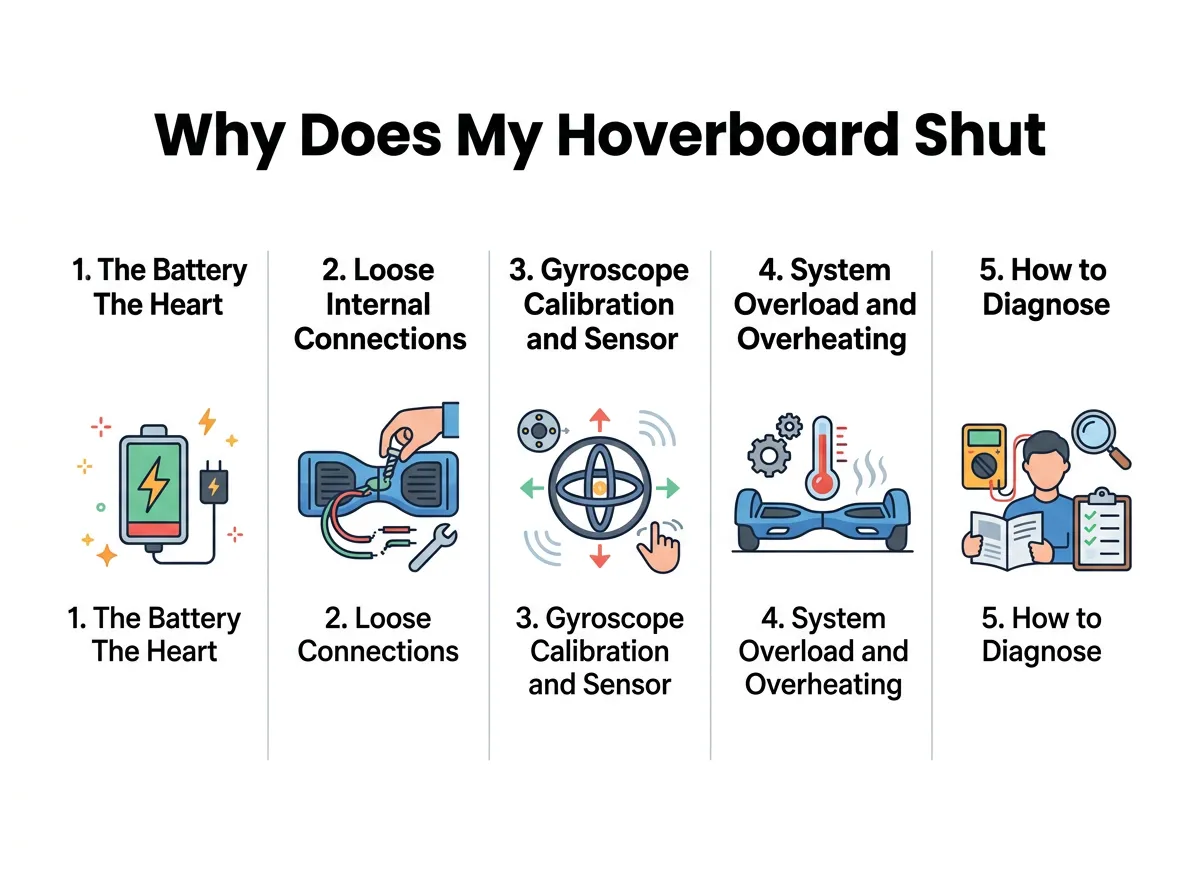
Why Does My Hoverboard Shut Off Randomly While Riding? — key points at a glance
The Vibration Factor
As you ride, your board rolls over bumps, cracks, and rough paths. These bumps cause constant vibrations. Over time, these tiny shakes can loosen the internal connections. If a power cable loses contact for even a split second, the board will lose power. It is like unplugging a lamp from the wall. The board shuts off, and you go flying.
According to online discussions about sudden hoverboard shutoffs, loose battery plugs are a very frequent culprit. These plugs can easily slip out of their sockets if they were not secured tightly at the factory.
How to Inspect Your Wires
Checking the wires is easier than it sounds. You will need a simple phillips-head screwdriver. Turn off your board first. Flip it over and remove the screws from the bottom plastic shell. Lift the cover off gently. Look for the thick wires running from the battery to the motherboard. Give each plug a gentle tug. If any plug feels loose, push it firmly back into its socket. You can also use a zip tie or some hot glue to keep them in place permanently.
Gyroscope Calibration and Sensor Glitches
Hoverboards balance by using clever sensors called gyroscopes. These sensors detect how you tilt your feet. They tell the motors how fast to spin. If the sensors get confused, the board may shut off as a safety measure.
What is the Gyroscope?
Think of the gyroscope as the board’s inner ear. It keeps track of what is level and what is not. Under each footpad, there is a physical sensor switch. When you step on the pad, you press this switch down. This tells the computer that a rider is on board. If your foot slips, or if the sensor is dirty, the board might think you fell off. To prevent a runaway board, it shuts down the motors instantly.
How to Calibrate Your Hoverboard
If your board shuts off on minor bumps, it might just need a reset. Calibrating the sensors is a quick fix you can do at home. Here is how to do it in five easy steps:
- Place your hoverboard on a completely flat, level floor.
- Make sure both sides of the board are perfectly level with each other.
- Press and hold the power button down for about 10 seconds.
- The lights on your board will start flashing, and you might hear a beep. Keep holding the button.
- Release the button and turn the board off. Turn it back on, and your sensors are now reset!
System Overload and Overheating
Sometimes, your board shuts off because you are asking it to do too much work. This is a built-in safety feature designed to stop the board from catching fire.
Steep Hills and Rough Grass
Hoverboards are built for smooth, flat surfaces like concrete. If you try to ride up a very steep hill, the motors have to work extra hard. The same thing happens when you ride through thick grass or thick carpet. This extra hard work creates a lot of heat. If the motherboard gets too hot, it will shut down the power to cool itself off. If you notice this happening, try to stick to flat, hard ground.
Weight Limit Constraints
Every hoverboard has a strict weight limit. For kids’ boards, this might be 120 pounds. For larger boards, it is usually 220 pounds. If a rider is too heavy for the board, the motors will draw too much current. This overcurrent triggers a safety switch. If you are close to the weight limit, you might find that the board turns off when you try to accelerate fast. You can learn more about how weight and load affect these devices on the StreetSaw guide on hoverboard power issues.
How to Diagnose Your Specific Issue
Now you know the main causes. But how do you find the exact problem with your own board? You can use a few simple clues to figure it out.
The Beep Code Clues
Most modern boards talk to you through beeps and flashing lights. When your board shuts off, pay close attention to what it does right before or right after. Does it beep three times? Does the red light flash? These flashes are actually diagnostic codes. Check your user manual to see what your specific flash pattern means. It will often point you directly to a bad battery or a bad sensor.
The “One Side Only” Test
Does your board only shut off when you step on one specific side? If so, you likely have a faulty sensor switch under that footpad. These switches can wear out or get stuck. If one side is dead while the other works, you may need to replace that specific gyroscope board.
Preventative Maintenance Tips
The best way to fix a hoverboard is to stop it from breaking in the first place. A little bit of care goes a long way.
Proper Charging Habits
Never leave your board plugged in overnight. Once the charger light turns green, unplug it. Overcharging ruins the battery life and can cause dangerous swelling. Also, never charge your board right after a ride. Let the battery cool down for 15 minutes first.
Safe Riding Practices
Avoid riding in the rain or through puddles. Most hoverboards are not waterproof. Water can seep inside and short out the circuit board. If this happens, your board will shut off and may never turn back on again. Also, try to avoid dropping your board or crashing into walls. Hard impacts can loosen internal plugs and crack the fragile casing.
Conclusion
Why Does My Hoverboard Shut Off Randomly While Riding? As we have seen, the most common culprits are weak batteries, loose internal wires, and sensor issues. Riding over rough ground or exceeding the weight limit can also trigger safety shutdowns.
By checking your battery, tightening loose plugs, and calibrating your sensors, you can fix most of these issues yourself. Always remember to ride safely, wear your helmet, and take good care of your board. Happy riding!
Frequently Asked Questions
Can a bad charger cause my hoverboard to turn off?
Yes, a damaged or cheap charger can prevent your battery from reaching a full, balanced charge. This leads to rapid voltage drops and sudden power cutoffs when you start riding. Always use the original manufacturer charger or a high-quality UL-certified replacement.
How long do hoverboard batteries usually last?
Most hoverboard batteries last between 1 to 2 years with regular use, or about 500 charge cycles. After this point, the cells degrade, lose voltage quickly under load, and cause the board to shut down randomly.
Why does my hoverboard beep and then turn off?
This is usually a safety warning indicating either a critically low battery or an internal system error like overheating. If calibration does not stop the beeping, you should inspect the battery voltage or look up the specific beep code in your user manual.
Can water damage cause sudden shutdowns?
Yes, water from puddles or rain can easily short out the motherboard and battery sensors. This short-circuiting will trigger an immediate emergency shutdown to prevent electrical fires, and it often ruins the circuit boards permanently.
Is it safe to ride a hoverboard that keeps shutting off?
No, it is highly unsafe to ride a board that cuts power randomly. A sudden shutdown will lock the wheels and can cause you to fall forward at high speed, leading to serious injuries. You should diagnose and fix the issue before riding again.
How much does it cost to replace a hoverboard battery?
A new, high-quality replacement battery typically costs between $30 and $70 depending on the model and brand. Replacing the battery is a simple process that you can easily do yourself with a basic screwdriver.
