
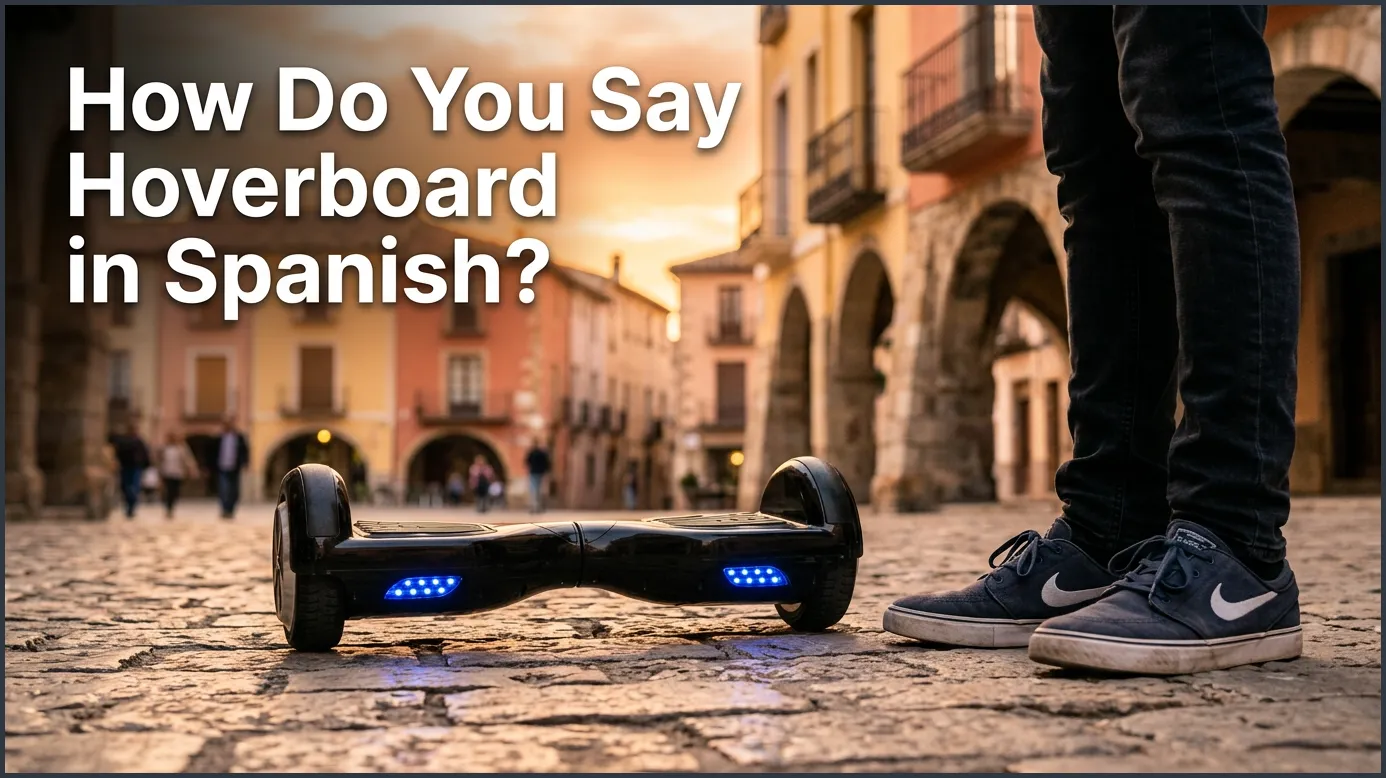
If you want to say hoverboard in Spanish, the most common term is “monopatín eléctrico” or simply the English word “hoverboard.” While different Spanish-speaking countries have their own regional slang, these two terms will help you be understood anywhere. Learning these words is a quick and fun way to boost your Spanish vocabulary today!
Imagine this fun scene. You are gliding down a bright street on a sunny afternoon. The wind is in your hair, and you feel like you are flying. You are riding your shiny new two-wheeled self-balancing board. Kids on the sidewalk look at you with wide eyes. You want to tell your friends about your cool new ride, but they only speak Spanish. You stop and think to yourself, how do you say hoverboard in Spanish?
It is a simple question, but the answer can be a bit tricky. Technology moves very fast. New gadgets come out every single year. Because of this, languages have to work hard to keep up with new inventions. Sometimes, people just use the English word. Other times, they create brand new terms in their own language. This can make learning new tech words in a second language a fun adventure.
In this beginner-friendly guide, we will explore this exact question. We will look at the most popular terms used by native speakers today. We will also explore how different countries choose to say it. Finally, we will share some easy pronunciation tips and useful phrases. By the end of this post, you will be ready to talk about your favorite ride with confidence!
Key Takeaways
- The English word is widely accepted: Many native speakers simply use the word “hoverboard” in daily speech.
- The formal translation is “monopatín eléctrico”: This term translates literally to “electric skateboard” and is safe to use anywhere.
- Regional terms vary: You will hear different words like “patineta eléctrica” or “patinete” depending on the country.
- Pronunciation changes slightly: Spanish speakers usually pronounce the English word with a soft “j” sound at the start.
- Context prevents confusion: Adding the word “eléctrico” helps people know you do not mean a regular skateboard.
📑 Table of Contents
- Why There Is No Single Word for Hoverboard in Spanish
- The Most Common Ways to Say Hoverboard in Spanish
- Regional Variations Across the Spanish-Speaking World
- Pronunciation Tips for Spanish Learners
- Practical Examples and Useful Phrases
- How to Avoid Confusion When Talking About Ride-On Toys
- Conclusion
Why There Is No Single Word for Hoverboard in Spanish
Languages are alive, and they change every single day. When a new product arrives on the market, people need a name for it. The hoverboard is a perfect example of this linguistic challenge.
The Rise of Modern Tech Words
In the past, we did not have these high-tech rides. When they first appeared in stores, people did not know what to call them. Some called them smart boards, while others called them self-balancing scooters. In Spanish, this caused some confusion. Should they use a pure Spanish word, or should they just copy the English word? Because of this, you will hear more than one term used in conversation today.
Borrowing from English
Many times, Spanish speakers just borrow words directly from English. This is extremely common with modern technology. Think of words like computer, smartphone, or internet. Often, people do not bother to translate them at all. They just adapt the word to their own pronunciation. According to this Quartz article on Spanish hoverboard terminology, the language has a lot of creative options because of this blend. Some people love using the English word, while others prefer a native term. Both ways are correct and very useful to know.
The Most Common Ways to Say Hoverboard in Spanish
Let us look at the top choices you have. If you need to talk about this ride, you have three main options. Let us break them down so you can choose the best one for your conversation.
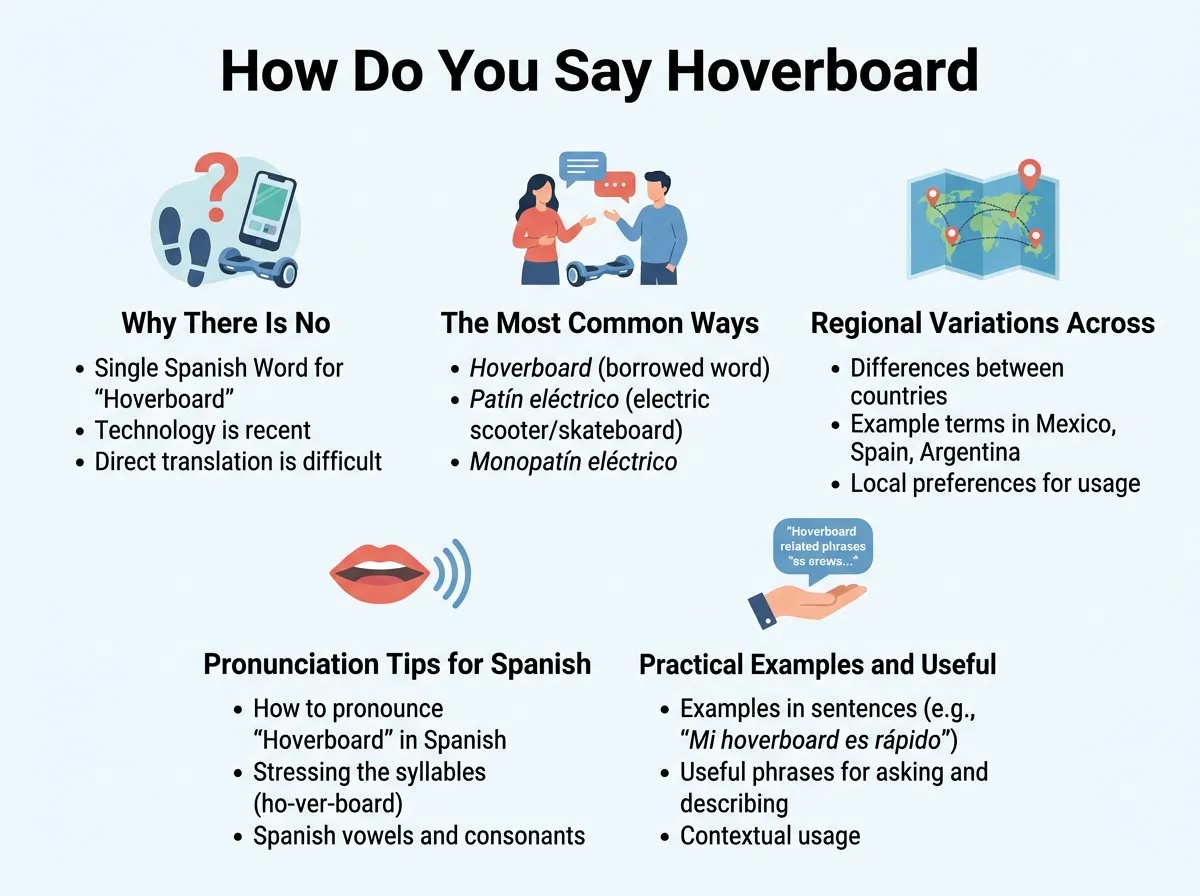
How Do You Say Hoverboard in Spanish? — key points at a glance
Option 1: El Hoverboard (The Anglicism)
Yes, you can just say “el hoverboard”! This is very common. Many young people in Spain and Latin America use this exact word. They write it just like we do in English, but they say it with a Spanish accent. We will talk about how to pronounce it in a moment. This is the easiest way to go. Most young speakers will know exactly what you mean right away.
Option 2: El Monopatín Eléctrico (The Safe Choice)
If you want to be formal and clear, use “el monopatín eléctrico.” This term translates to “electric skateboard” or “electric scooter” in a broad sense. It is a very safe term to use in any setting. It sounds natural, polite, and grammatically correct. You can find this on the Cambridge English-Spanish Dictionary page as a top translation. It is perfect for writing essays, speaking with teachers, or chatting in a formal setting.
Option 3: La Tabla Deslizadora (The Sci-Fi Touch)
Do you love movies? In the classic movie “Back to the Future,” there is a real floating board. In the Spanish version of the movie, that board is called “la tabla deslizadora.” This means “sliding board” or “floating board.” Some people still use this term for modern two-wheeled boards. It sounds a bit like science fiction, but it is very descriptive and fun. You can see how these terms map out on the SpanishDict translation page.
Regional Variations Across the Spanish-Speaking World
Spanish is spoken in dozens of countries. Each place has its own unique style and slang. Let us see how different regions talk about this popular ride.
How They Say It in Spain
In Spain, people love to adopt English words for tech. You will hear “el hoverboard” very often in major cities like Madrid and Barcelona. You might also hear “patinete eléctrico.” This word usually means an electric scooter with handlebars. However, some people use it for hoverboards too. It is always good to pay attention to the context of the conversation.
How They Say It in Mexico and Central America
Mexico shares a long border with the United States. Because of this, Mexican Spanish uses a lot of English terms. “El hoverboard” is very common here. You will also hear “patineta eléctrica.” In Mexico, “patineta” is the word for skateboard. So, adding “eléctrica” makes it an electric skateboard. It is a very friendly and common term to use.
How They Say It in South America
In countries like Argentina, Colombia, or Chile, terms can vary quite a bit. Some people use “monopatín eléctrico” for almost any small electric ride. Others might prefer “patinete.” In Colombia, you might even hear “tabla eléctrica.” It is always a fun adventure to see which word is popular in each city. If you travel, just ask the locals how they say it!
Pronunciation Tips for Spanish Learners
How do you say these words out loud? Pronunciation is key to being understood. Let us look at how to say them like a native.
Pronouncing the English Word in Spanish
If you choose to use the word “hoverboard,” you must adapt it. Spanish does not have a strong breathy “h” sound like English. In Spanish, the letter “h” is usually completely silent. However, for borrowed English words, Spanish speakers often use a “j” sound. This sound is like the “h” in the English word “home,” but slightly stronger. So, you would say “jover-bord.” The “r” sounds are also short and quick. Try saying “el joverbord.” It will sound very natural to native ears!
Pronouncing “Monopatín Eléctrico”
This is a pure Spanish term. It has five syllables: mo-no-pa-tín. The stress is on the very last syllable because of the written accent mark on the letter “í.” The word “eléctrico” has four syllables: e-léc-tri-co. The stress is on the “léc” syllable. Let us put it together: “mo-no-pa-TÍN e-LÉC-tri-co.” Say it slowly at first. Then, speed up. You will sound like a pro in no time!
Practical Examples and Useful Phrases
Let us put these words into real sentences. Here are some simple phrases you can practice using today.
Asking for a Ride
Want to try your friend’s new board? Here is how to ask politely in Spanish:
- “¿Me dejas probar tu monopatín eléctrico?” (Will you let me try your electric board?)
- “¡Qué genial está tu hoverboard!” (Your hoverboard is so cool!)
- “¿Dónde compraste esa tabla deslizadora?” (Where did you buy that sliding board?)
Talking About Your Day
Want to share what you did over the weekend? Try these simple sentences:
- “Hoy aprendí a montar en hoverboard.” (Today I learned to ride a hoverboard.)
- “Mi hermano se cayó de la patineta eléctrica.” (My brother fell off the electric skateboard.)
- “Tengo que cargar la batería de mi monopatín.” (I need to charge my board’s battery.)
How to Avoid Confusion When Talking About Ride-On Toys
There are many new ride-on toys on the streets today. It is very easy to mix them up. Let us make sure you use the right word for the right toy.
Skateboards vs. Hoverboards
A regular skateboard is “una patineta” or “un monopatín.” It does not have a motor. You must use your foot to push it along the ground. A hoverboard has a motor and built-in sensors. If you want to make sure people know you mean a hoverboard, always add the word “eléctrico.” This keeps things clear.
Scooters vs. Hoverboards
A traditional scooter has handlebars that you hold onto. In Spanish, this is “un patinete” or “un monopatín.” A hoverboard does not have handlebars. You must balance using only your feet. If you just say “patinete,” some people might picture a scooter with handles. If you want to be precise, use “hoverboard” or “tabla de auto-equilibrio” (self-balancing board).
Conclusion
Now you know the answer to your question. How do you say hoverboard in Spanish? You have a few great choices. You can use the easy English word “el hoverboard.” You can use the formal and safe “el monopatín eléctrico.” Or you can use regional terms like “la patineta eléctrica” depending on where you are traveling.
No matter which word you choose, the most important thing is to have fun with the language. Learning a new language is very much like riding a hoverboard. It takes a little bit of practice and balance at first. However, once you get the hang of it, it is an amazing and rewarding ride. So, go out there, be brave, and practice your new Spanish words today!
Frequently Asked Questions
Is hoverboard understood in all Spanish-speaking countries?
Yes, the English word hoverboard is widely understood in almost all Spanish-speaking countries, especially among younger people and tech fans. You can use it in casual conversations without any issues.
What is the most formal way to say hoverboard in Spanish?
The most formal and correct way to say it is “el monopatín eléctrico.” This term is highly recognized, polite, and perfect for formal writing or classroom settings.
How do you pronounce hoverboard with a Spanish accent?
To say it like a native, pronounce the starting “h” as a soft Spanish “j” sound, which sounds like the “h” in “home.” It ends up sounding like “jover-bord.”
Is there a difference between patinete and hoverboard?
Yes, “patinete” usually refers to a scooter with handlebars that you hold. A hoverboard does not have handlebars, so adding “eléctrico” or using the English word helps clear up any confusion.
How do you say electric scooter in Spanish?
An electric scooter with handlebars is usually called “un patinete eléctrico” in Spain, or “un monopatín eléctrico” in many parts of Latin America.
Can I use the word patineta for a hoverboard?
You can use “patineta eléctrica” in countries like Mexico, where “patineta” means skateboard. Adding “eléctrica” makes it clear that you are talking about a motorized board.
