


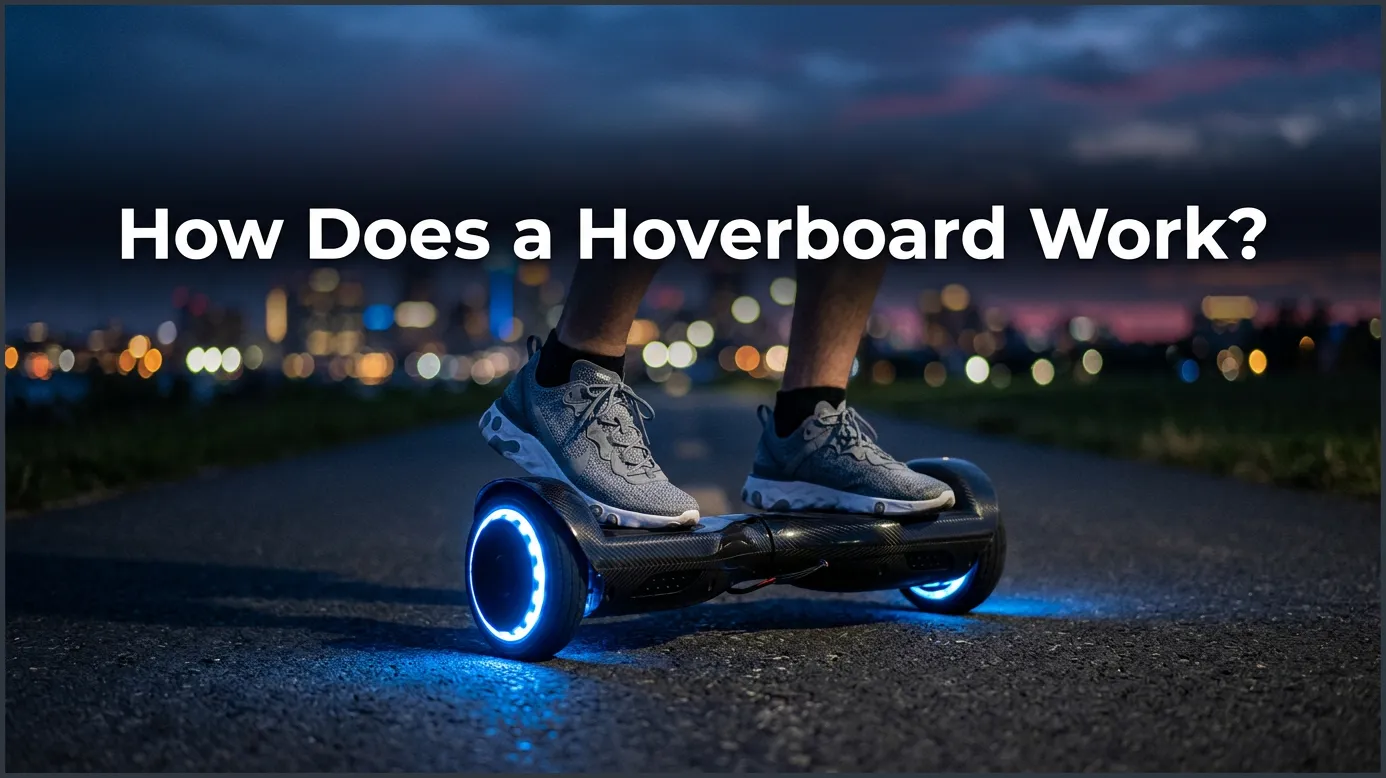
A hoverboard works by using a clever combination of gyroscopes, microprocessors, and electric motors to maintain balance. When you tilt your feet forward or backward, tilt sensors detect the shift in your weight and tell the brain of the board to spin the wheels. This instant feedback loop keeps you upright while moving you smoothly in your chosen direction.
Imagine gliding down the street without taking a single step. You lean forward slightly, and you zoom ahead. You lean back, and you slow down to a smooth stop. It feels like real magic, right out of a classic sci-fi movie. When self-balancing scooters first hit the scene, they took the world by storm. Everyone wanted to try them, from kids in the neighborhood to major celebrities on social media.
You might ask yourself: how does a hoverboard work under the hood? It has no handlebars. It has no steering wheel. Yet, it seems to read your mind with every tilt of your feet. It is not actually magic that keeps you upright and moving. Instead, it is a brilliant mix of smart sensors, electric motors, and computer chips working together in real time.
In this easy guide, we will open up this cool gadget and look inside. We will break down the science of balance in simple terms. By the end, you will know exactly what happens under your feet every time you go for a ride. Plus, we will share some handy tips to help you ride like a pro.
Key Takeaways
- Gyroscopes are key: These sensors detect changes in pitch and tilt to keep the board stable.
- Microprocessors act as the brain: They receive data from sensors and send instant commands to the motors.
- Tilt sensors track weight: Infrared sensors detect how far forward or backward your feet are leaning.
- Independent electric motors: Each wheel has its own motor, allowing for sharp turns and 360-degree spins.
- Rechargeable lithium-ion batteries: They supply the high power needed to run the motors and computers.
- Rider control is intuitive: You steer and accelerate simply by shifting your center of gravity.
📑 Table of Contents
The Core Anatomy of a Hoverboard
To understand the big question, how does a hoverboard work, we must first look at its body parts. A hoverboard is not just one solid piece of plastic. It is a highly engineered machine made of several key components that fit together like a puzzle.
The Split Frame and Pivot Point
At first glance, a hoverboard looks like a single platform. But if you look closely, you will see it is split in the middle. The left side and the right side can twist independently. This split frame is held together by a central pivot pin. This clever design is crucial because it allows your left foot and right foot to tilt at different angles. Without this pivot point, you would not be able to steer the board at all.
The Wheels and In-Hub Motors
The wheels are where the action happens. Inside each wheel, you will find a powerful electric motor. These are called hub motors because they sit directly inside the wheel hubs. This design saves space and gives the board instant power. When the motor spins, the wheel spins. Because each wheel has its own independent motor, they can spin at different speeds or even in opposite directions. This is what allows you to spin in a circle on the spot.
The Brains and the Senses
How does a hoverboard work when it comes to keeping its balance? It needs a way to feel where it is in space. Just like your body uses your inner ear to stay upright, a hoverboard uses smart sensors to detect movement.
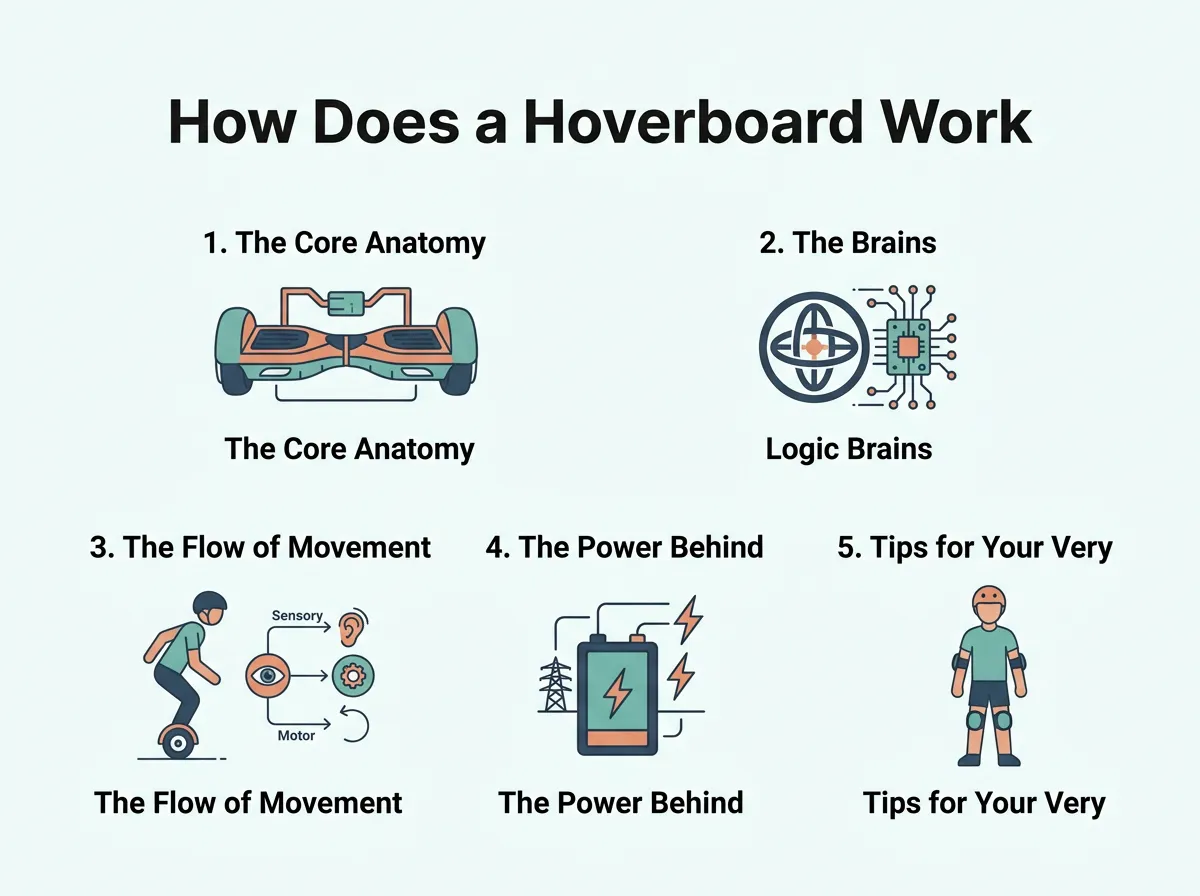
How Does a Hoverboard Work? — key points at a glance
The Logic Board: The Smart Brain
Deep inside the hoverboard sits the main logic board, often called the motherboard. This is the brain of the entire machine. It is a small computer chip that constantly receives information from all the sensors. It processes this data in a fraction of a second. Then, it sends instant commands to the motors, telling them how fast to spin and in which direction.
Gyroscopes: The Balance Keepers
Gyroscopes are the star players in any self-balancing scooter. But what are they, and how does a hoverboard work with them? A gyroscope is a clever sensor that measures changes in pitch, roll, and yaw. In simple terms, it knows if the board is flat, tilted forward, or tilted backward. Every hoverboard has two gyroscopes—one for each foot platform. They send constant angle data to the brain to make sure you do not tip over.
Infrared Tilt Sensors
Beneath the rubber footpads lie infrared tilt sensors. When you step on the board, your feet push down on the rubber pads. This action slides a small plastic wall between an infrared light and a sensor. When the light is blocked, the board knows you are stepping on it. It also measures how far forward or backward you are leaning based on how much light is blocked. This gives the brain precise data on your foot movements.
The Flow of Movement: How It All Comes Together
Now that we know the parts, let us look at the process in action. How does a hoverboard work when you actually start riding it? The magic lies in a continuous, lightning-fast feedback loop.
Stepping On the Board
When you place your first foot on the board, the pressure activates the first infrared sensor. The board wakes up but waits for your second foot. Once both feet are on, the logic board engages the self-balancing mode. The gyroscopes start reading your position immediately, keeping the board stable while you find your footing.
Moving Forward and Backward
To move forward, you do not actually lean your whole body forward. That would make you fall! Instead, you gently press down with your toes. This tilts the front of the footpads downward. The gyroscopes and tilt sensors detect this change in angle and send a message to the brain. The brain says, “The rider is leaning forward, so spin the wheels forward to keep up with them!” The motors spin the wheels, and you glide forward. To go backward or slow down, you simply press down with your heels.
How to Turn and Spin
Turning is where the split frame shines. To turn left, you press down with your right toes. This tells the right wheel to spin forward. At the same time, you keep your left foot flat or press down with your left heel. This keeps the left wheel still or makes it move backward. When the right wheel goes forward and the left wheel stays still, your board naturally swings to the left. If you push one foot forward and one foot back, you will spin in a thrilling circle!
The Power Behind the Ride: Lithium-Ion Batteries
None of this amazing technology would work without a reliable power source. Hoverboards rely on rechargeable lithium-ion battery packs. These batteries are similar to the ones inside your smartphone, but they are much larger and more powerful. They must deliver high voltage to the motors while powering the computer brain and LED lights at the same time.
In the early days of hoverboards, some low-quality batteries had issues with overheating. Today, safety standards are much stricter. Modern hoverboards must pass tough safety tests to get a UL 2272 certification. This certificate ensures that the battery, charger, and electrical systems are completely safe to use. Always look for this seal when buying a hoverboard.
Tips for Your Very First Hoverboard Ride
Learning how does a hoverboard work is great, but getting on one for the first time can still feel a bit scary. Here are some quick, friendly tips to help you get rolling safely:
- Find a helper: Have a friend hold your hands or stand near a sturdy wall when you first step on. This will help you find your balance without falling.
- Look straight ahead: It is natural to want to look down at your feet, but this shifts your balance. Look ahead to where you want to go.
- Step on from behind: Always step onto the board from the back, one foot at a time. Step off the same way—by stepping backward off the board. Stepping off the front is a common cause of falls.
- Keep a relaxed posture: Bend your knees slightly. Do not stiffen your legs. A relaxed body can adjust to small bumps much easier than a stiff one.
- Start with tiny movements: You do not need to lean hard. Just a tiny squeeze of your toes is all it takes to move. Treat the board like an extension of your own feet.
Conclusion
So, how does a hoverboard work? It is a wonderful blend of modern engineering and simple physics. By using a split frame, sensitive gyroscopes, and smart computer brains, the board is able to mimic your body’s natural balance. It translates the tiny movements of your feet into smooth, electric speed. It is a mini-computer on wheels that makes you feel like you are floating.
Now that you know the secrets behind the ride, you can appreciate the smart tech under your feet even more. Strap on your helmet, step onto the deck, and enjoy the ride!
Frequently Asked Questions
Do hoverboards actually hover above the ground?
No, real-life hoverboards do not actually float in the air. They use rubber wheels to roll smoothly on the ground while giving you a floating sensation. The name comes from their resemblance to the flying boards seen in science fiction movies.
How does a hoverboard know when to stop?
A hoverboard stops when you return your feet to a completely flat, neutral position. The gyroscopes detect that you are no longer tilting forward or backward. Once the tilt angle returns to zero, the logic board tells the motors to stop spinning.
Is it hard to learn how to ride a hoverboard?
Most beginners can learn the basics of riding a hoverboard in about 10 to 15 minutes. It takes a little practice to feel fully confident, but the smart self-balancing sensors do most of the hard work for you. Starting with a friend nearby to hold your hand makes the process much easier.
What keeps a hoverboard from tipping over?
The main stabilizers are the built-in gyroscopes and acceleration sensors. These parts measure the tilt of the board hundreds of times per second and feed this data to the logic board. The brain then instantly adjusts the wheels to keep the platform level and stable under your feet.
Are hoverboards safe to ride today?
Yes, modern hoverboards are very safe as long as they carry the UL 2272 safety certification. This certification guarantees that the battery and electrical systems have passed rigorous safety tests. Always wear protective gear like a helmet and pads, especially when you are first learning.
Can you ride a hoverboard on grass or gravel?
It depends on the size of your hoverboard’s wheels. Standard hoverboards with 6.5-inch wheels are best for flat, smooth surfaces like concrete. If you want to ride on grass, gravel, or dirt, you should look for an all-terrain hoverboard with larger, knobby wheels.does a hoverboard work?using a clever combination of gyroscopes, microprocessors, and electric motors to maintain balance. When you tilt your feet forward or backward, tilt sensors detect the shift in your weight and tell the brain of the board to spin the wheels. This instant feedback loop keeps you upright while moving you smoothly in your chosen direction.
Imagine gliding down the street without taking a single step. You lean forward slightly, and you zoom ahead. You lean back, and you slow down to a smooth stop. It feels like real magic, right out of a classic sci-fi movie. When self-balancing scooters first hit the scene, they took the world by storm. Everyone wanted to try them, from kids in the neighborhood to major celebrities on social media.
You might ask yourself: how does a hoverboard work under the hood? It has no handlebars. It has no steering wheel. Yet, it seems to read your mind with every tilt of your feet. It is not actually magic that keeps you upright and moving. Instead, it is a brilliant mix of smart sensors, electric motors, and computer chips working together in real time.
In this easy guide, we will open up this cool gadget and look inside. We will break down the science of balance in simple terms. By the end, you will know exactly what happens under your feet every time you go for a ride. Plus, we will share some handy tips to help you ride like a pro.
Key Takeaways
- Gyroscopes are key: These sensors detect changes in pitch and tilt to keep the board stable.
- Microprocessors act as the brain: They receive data from sensors and send instant commands to the motors.
- Tilt sensors track weight: Infrared sensors detect how far forward or backward your feet are leaning.
- Independent electric motors: Each wheel has its own motor, allowing for sharp turns and 360-degree spins.
- Rechargeable lithium-ion batteries: They supply the high power needed to run the motors and computers.
- Rider control is intuitive: You steer and accelerate simply by shifting your center of gravity.
📑 Table of Contents
The Core Anatomy of a Hoverboard
To understand the big question, how does a hoverboard work, we must first look at its body parts. A hoverboard is not just one solid piece of plastic. It is a highly engineered machine made of several key components that fit together like a puzzle.
The Split Frame and Pivot Point
At first glance, a hoverboard looks like a single platform. But if you look closely, you will see it is split in the middle. The left side and the right side can twist independently. This split frame is held together by a central pivot pin. This clever design is crucial because it allows your left foot and right foot to tilt at different angles. Without this pivot point, you would not be able to steer the board at all.
The Wheels and In-Hub Motors
The wheels are where the action happens. Inside each wheel, you will find a powerful electric motor. These are called hub motors because they sit directly inside the wheel hubs. This design saves space and gives the board instant power. When the motor spins, the wheel spins. Because each wheel has its own independent motor, they can spin at different speeds or even in opposite directions. This is what allows you to spin in a circle on the spot.
The Brains and the Senses
How does a hoverboard work when it comes to keeping its balance? It needs a way to feel where it is in space. Just like your body uses your inner ear to stay upright, a hoverboard uses smart sensors to detect movement.
How Does a Hoverboard Work? — key points at a glance
The Logic Board: The Smart Brain
Deep inside the hoverboard sits the main logic board, often called the motherboard. This is the brain of the entire machine. It is a small computer chip that constantly receives information from all the sensors. It processes this data in a fraction of a second. Then, it sends instant commands to the motors, telling them how fast to spin and in which direction.
Gyroscopes: The Balance Keepers
Gyroscopes are the star players in any self-balancing scooter. But what are they, and how does a hoverboard work with them? A gyroscope is a clever sensor that measures changes in pitch, roll, and yaw. In simple terms, it knows if the board is flat, tilted forward, or tilted backward. Every hoverboard has two gyroscopes—one for each foot platform. They send constant angle data to the brain to make sure you do not tip over.
Infrared Tilt Sensors
Beneath the rubber footpads lie infrared tilt sensors. When you step on the board, your feet push down on the rubber pads. This action slides a small plastic wall between an infrared light and a sensor. When the light is blocked, the board knows you are stepping on it. It also measures how far forward or backward you are leaning based on how much light is blocked. This gives the brain precise data on your foot movements.
The Flow of Movement: How It All Comes Together
Now that we know the parts, let us look at the process in action. How does a hoverboard work when you actually start riding it? The magic lies in a continuous, lightning-fast feedback loop.
Stepping On the Board
When you place your first foot on the board, the pressure activates the first infrared sensor. The board wakes up but waits for your second foot. Once both feet are on, the logic board engages the self-balancing mode. The gyroscopes start reading your position immediately, keeping the board stable while you find your footing.
Moving Forward and Backward
To move forward, you do not actually lean your whole body forward. That would make you fall! Instead, you gently press down with your toes. This tilts the front of the footpads downward. The gyroscopes and tilt sensors detect this change in angle and send a message to the brain. The brain says, “The rider is leaning forward, so spin the wheels forward to keep up with them!” The motors spin the wheels, and you glide forward. To go backward or slow down, you simply press down with your heels.
How to Turn and Spin
Turning is where the split frame shines. To turn left, you press down with your right toes. This tells the right wheel to spin forward. At the same time, you keep your left foot flat or press down with your left heel. This keeps the left wheel still or makes it move backward. When the right wheel goes forward and the left wheel stays still, your board naturally swings to the left. If you push one foot forward and one foot back, you will spin in a thrilling circle!
The Power Behind the Ride: Lithium-Ion Batteries
None of this amazing technology would work without a reliable power source. Hoverboards rely on rechargeable lithium-ion battery packs. These batteries are similar to the ones inside your smartphone, but they are much larger and more powerful. They must deliver high voltage to the motors while powering the computer brain and LED lights at the same time.
In the early days of hoverboards, some low-quality batteries had issues with overheating. Today, safety standards are much stricter. Modern hoverboards must pass tough safety tests to get a UL 2272 certification. This certificate ensures that the battery, charger, and electrical systems are completely safe to use. Always look for this seal when buying a hoverboard.
Tips for Your Very First Hoverboard Ride
Learning how does a hoverboard work is great, but getting on one for the first time can still feel a bit scary. Here are some quick, friendly tips to help you get rolling safely:
- Find a helper: Have a friend hold your hands or stand near a sturdy wall when you first step on. This will help you find your balance without falling.
- Look straight ahead: It is natural to want to look down at your feet, but this shifts your balance. Look ahead to where you want to go.
- Step on from behind: Always step onto the board from the back, one foot at a time. Step off the same way—by stepping backward off the board. Stepping off the front is a common cause of falls.
- Keep a relaxed posture: Bend your knees slightly. Do not stiffen your legs. A relaxed body can adjust to small bumps much easier than a stiff one.
- Start with tiny movements: You do not need to lean hard. Just a tiny squeeze of your toes is all it takes to move. Treat the board like an extension of your own feet.
Conclusion
So, how does a hoverboard work? It is a wonderful blend of modern engineering and simple physics. By using a split frame, sensitive gyroscopes, and smart computer brains, the board is able to mimic your body’s natural balance. It translates the tiny movements of your feet into smooth, electric speed. It is a mini-computer on wheels that makes you feel like you are floating.
Now that you know the secrets behind the ride, you can appreciate the smart tech under your feet even more. Strap on your helmet, step onto the deck, and enjoy the ride!
Frequently Asked Questions
Do hoverboards actually hover above the ground?
No, real-life hoverboards do not actually float in the air. They use rubber wheels to roll smoothly on the ground while giving you a floating sensation. The name comes from their resemblance to the flying boards seen in science fiction movies.
How does a hoverboard know when to stop?
A hoverboard stops when you return your feet to a completely flat, neutral position. The gyroscopes detect that you are no longer tilting forward or backward. Once the tilt angle returns to zero, the logic board tells the motors to stop spinning.
Is it hard to learn how to ride a hoverboard?
Most beginners can learn the basics of riding a hoverboard in about 10 to 15 minutes. It takes a little practice to feel fully confident, but the smart self-balancing sensors do most of the hard work for you. Starting with a friend nearby to hold your hand makes the process much easier.
What keeps a hoverboard from tipping over?
The main stabilizers are the built-in gyroscopes and acceleration sensors. These parts measure the tilt of the board hundreds of times per second and feed this data to the logic board. The brain then instantly adjusts the wheels to keep the platform level and stable under your feet.
Are hoverboards safe to ride today?
Yes, modern hoverboards are very safe as long as they carry the UL 2272 safety certification. This certification guarantees that the battery and electrical systems have passed rigorous safety tests. Always wear protective gear like a helmet and pads, especially when you are first learning.
Can you ride a hoverboard on grass or gravel?
It depends on the size of your hoverboard’s wheels. Standard hoverboards with 6.5-inch wheels are best for flat, smooth surfaces like concrete. If you want to ride on grass, gravel, or dirt, you should look for an all-terrain hoverboard with larger, knobby wheels.
