


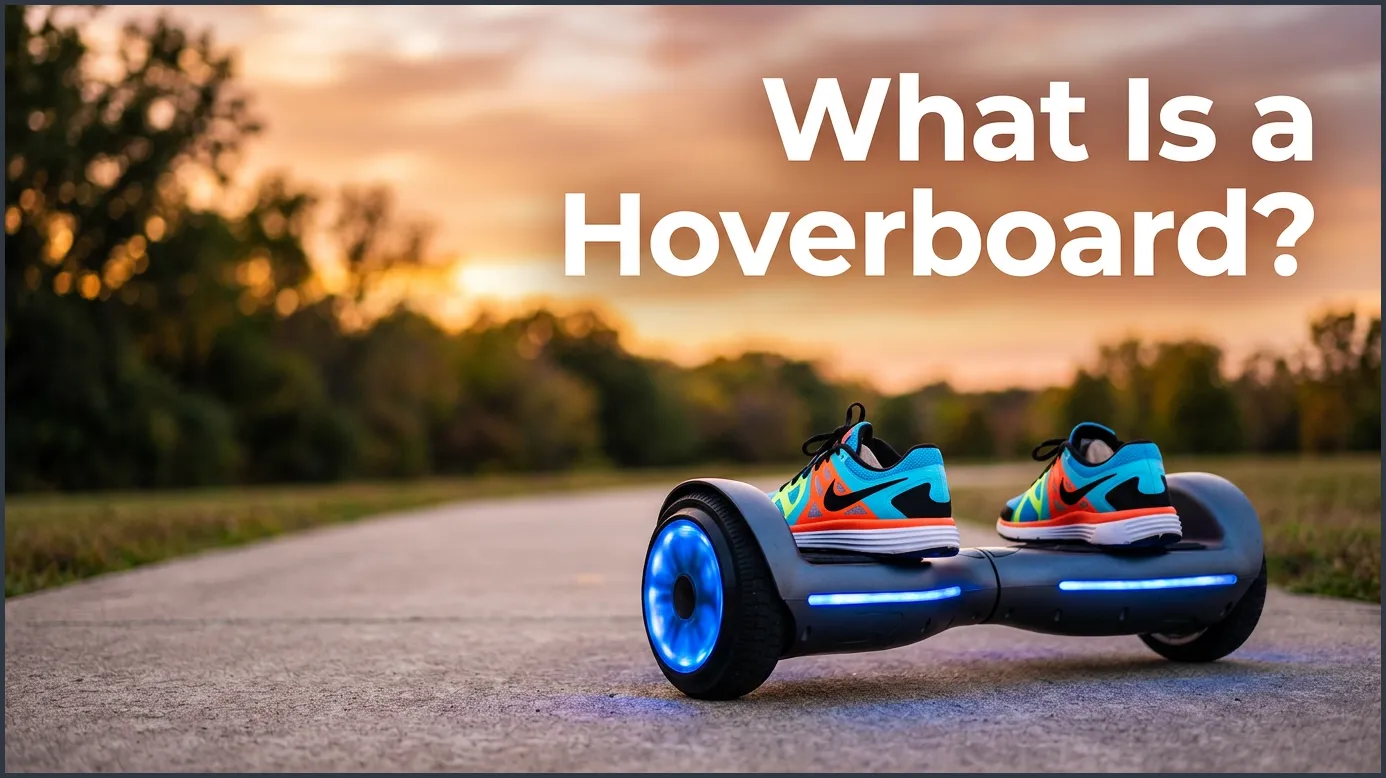
A hoverboard is a portable, rechargeable battery-powered scooter with two wheels arranged side-by-side. It uses internal gyroscopes and acceleration sensors to let riders balance, steer, and move forward or backward simply by shifting their body weight. These popular personal transporters are widely used for fun, short commutes, and modern outdoor recreation.
Imagine zooming down your street. Your feet are planted on a sleek, glowing deck. You do not have to pedal. You do not have to push off the ground. You simply lean forward, and away you go! It feels like magic. However, it is actually smart science. This exciting device has taken the world by storm. It has changed the way we think about short trips and outdoor play.
Have you seen people gliding effortlessly through parks? If so, you might have wondered: What Is a Hoverboard? You are not alone. Millions of people ask this question every year. It is one of the most talked-about tech gadgets of the last decade. But what lies beneath that colorful, flashing exterior? How does a device with only two wheels keep you from falling over?
Before you buy one, you should ask: What Is a Hoverboard? In this beginner-friendly guide, we will dive deep into everything you need to know. We will explore the origins of this popular gadget. We will explain how the technology works in simple terms. We will also cover safety features, riding tips, and how to choose the best model. By the end, you will be a true expert on these modern ride-on toys.
Key Takeaways
- Self-Balancing Tech: Hoverboards rely on clever gyroscopes and sensors to detect your body tilt and keep you upright.
- Two-Wheeled Design: Unlike the floating boards in movies, real-world hoverboards are hands-free motorized scooters with two parallel wheels.
- Easy to Learn: Most people can master the basic steering and balance within just fifteen to thirty minutes of practice.
- Safety Standards: Modern hoverboards must have UL 2272 certification to ensure the battery and charger are completely safe.
- Varied Terrains: While basic models work best on smooth pavements, all-terrain hoverboards can handle grass, gravel, and dirt.
- Fun Extra Features: Many models come with built-in Bluetooth speakers, flashing LED lights, and custom smartphone apps.
📑 Table of Contents
The Origin: What Is a Hoverboard in Pop Culture vs. Reality?
To understand this device, we must look at where the name came from. The word “hoverboard” once belonged strictly to science fiction. Many people first saw this term in famous movies from the late 1980s. In those films, a hoverboard was a skateboard that could levitate. It floated in the air with no wheels at all. It was the ultimate dream for kids who wanted to fly. You can read more about the history and concept of a levitating board on Wikipedia.
But reality took a different turn. When real-world inventors created a new type of personal transporter, they needed a catchy name. They chose to call it a hoverboard. While these real boards do not levitate, they still feel like they do. They glide so smoothly over concrete that you feel like you are floating. Today, when people ask, “What Is a Hoverboard?” they are referring to a self-balancing electric scooter. This modern device is part of a broad family of personal transporter options that are changing urban travel.
So, what is a hoverboard in the physical sense? It is a hands-free scooter. It features a middle platform where you stand. On each side of this platform, there is a large, motorized wheel. It does not have any handlebars. Instead, you steer using only your feet and your body weight. It is a brilliant blend of balance, battery power, and smart engineering.
How Do Hoverboards Actually Work?
It might look like magic, but the way these devices operate is quite simple. When learning how a hoverboard functions, you only need to understand a few basic parts. These parts work together in perfect harmony to keep you upright.
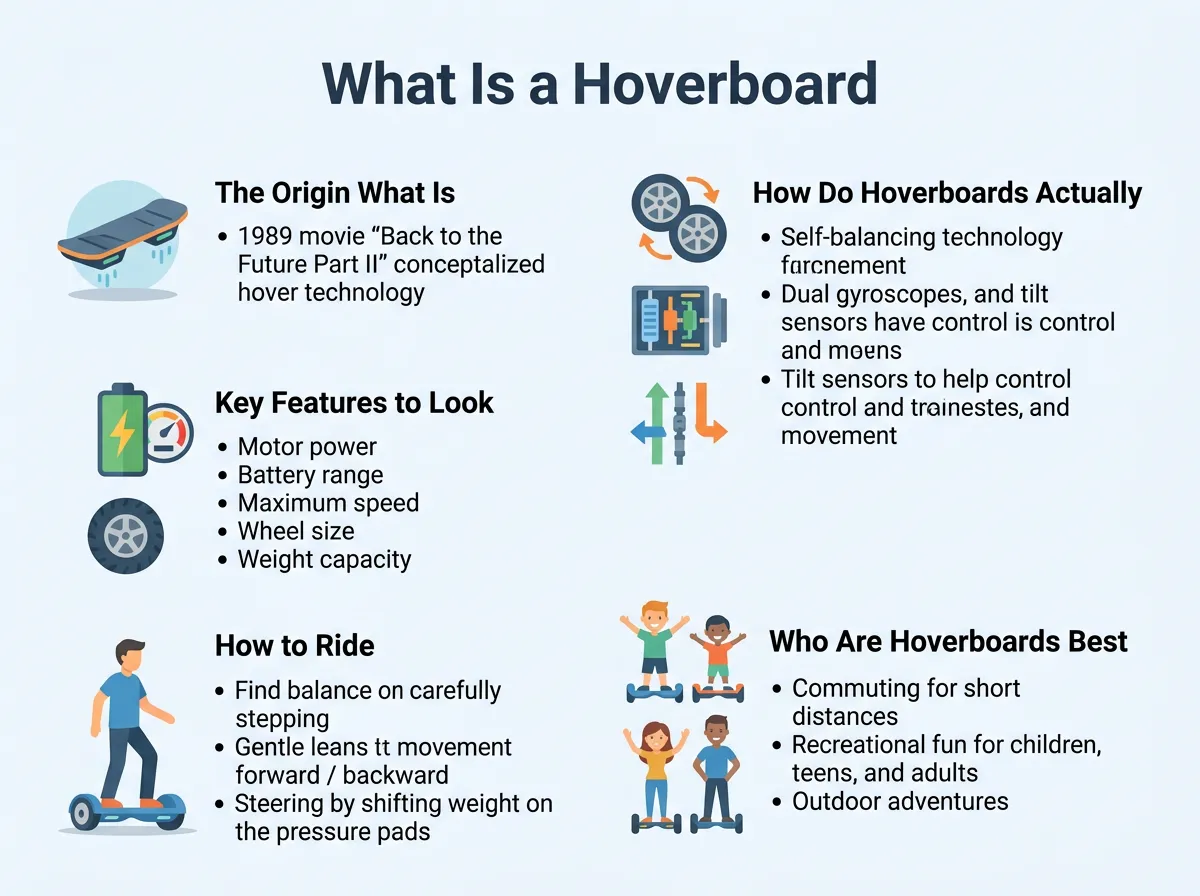
What Is a Hoverboard? — key points at a glance
The Role of Gyroscopes and Sensors
To truly answer what is a hoverboard, we have to look inside. The secret to the hoverboard is the gyroscope. Each wheel hub has its own gyroscope and tilt sensor. These sensors are incredibly smart. They detect even the tiniest changes in angle. When you lean forward, the sensor notices. It tells the board to move forward to keep under your center of gravity. When you lean back, the board slows down or moves backward. This constant, micro-adjusting cycle is what keeps you balanced. It happens in milliseconds.
The Electric Motor and Battery
Under the plastic shell lies a powerful lithium-ion battery. This battery sends power to electric motors. Usually, each wheel has its own motor. This dual-motor setup is crucial. It allows the wheels to spin at different speeds. For example, if you want to turn left, the right wheel will spin faster. If you want to spin in a circle, one wheel goes forward while the other goes backward. It is highly responsive and very agile.
Key Features to Look For When Buying
Are you thinking about buying one? If so, you will find many different models on the market. Understanding what is a hoverboard and what features are worth paying for will help you save money. Here are the most important details to keep in mind.
Wheel Size and Terrain Capability
When thinking about what is a hoverboard, you must also look at wheel sizes. Hoverboard wheels come in several sizes. The most common size is 6.5 inches. These are great for kids. They work best on smooth indoor floors and flat pavements. If you want to ride on grass or gravel, you should look for larger wheels. Wheels that are 8.5 inches or 10 inches are ideal for rough ground. These are often called all-terrain hoverboards. They have thick, rubber tires with deep treads.
Safety Certifications
Safety should always be your top priority. In the early days, some cheap boards had battery issues. Today, that problem is solved. If you want to know what is a hoverboard safety guarantee, look for the UL 2272 logo. This label means the board has passed strict safety tests. It guarantees that the electrical system, battery, and charger are safe to use. Never buy a board without this certification.
Battery Life and Speed
Most hoverboards can travel at speeds of 6 to 10 miles per hour. That might sound slow, but it feels quite fast when you are standing on it! A single charge will usually last for 45 to 90 minutes of riding. This range depends on the rider’s weight and the steepness of the hills. Always check the charging time too. A good board should fully charge in two to three hours.
How to Ride a Hoverboard Safely
Riding for the first time can feel a bit scary. Your muscles might tense up. But do not worry! Now that you can answer what is a hoverboard, let us learn how to ride one safely with a few simple steps.
Stepping On and Off
This is where most beginners make mistakes. To step on, place your dominant foot firmly on the board first. Make sure your foot is as close to the wheel as possible. This position gives you the best control. Once that foot is stable, quickly step up with your other foot. Try to look straight ahead, not down at your feet. Looking down can throw off your natural balance. To step off, always step backward, never forward. Stepping forward can cause the board to shoot out beneath you.
Steering and Stopping
To move forward, gently lean the balls of your feet downward. Do not bend your waist. Keep your body straight and just tilt your ankles. To stop, simply stand up straight. Your body will naturally find its center, and the board will come to a halt. To turn, push your left toes down to turn right, and your right toes down to turn left. It feels very intuitive once you try it.
Who Are Hoverboards Best Suited For?
These devices are not just for kids anymore. The evolution of personal electric vehicles has made them popular across all age groups. Let us look at who benefits most from owning one.
Kids and Teens
For a parent asking what is a hoverboard good for, the answer is simple: active play. For younger riders, a hoverboard is the ultimate backyard toy. It gets them outside and away from screens. It helps them develop excellent balance and coordination. Many kid-friendly models have built-in speed limiters. This feature keeps young riders safe while they learn.
Daily Commuters
When a commuter asks what is a hoverboard going to do for my routine, the answer is saving time. Do you live close to your office or school? A hoverboard can be a fantastic way to travel. It is eco-friendly and very cheap to run. You do not have to worry about parking or gas. You can simply ride to your destination, pick up the lightweight board, and carry it inside. It easily fits under a desk or in a locker.
Conclusion
So, what is a hoverboard? It is more than just a toy. It is a marvelous piece of modern engineering. It bridges the gap between fun recreation and practical urban transport. By using gyroscopes, smart sensors, and electric motors, it offers a riding experience like no other. Whether you want to enjoy a sunny afternoon in the park or speed up your daily commute, a hoverboard is a fantastic choice. Just remember to wear your safety gear, choose a certified model, and have fun gliding into the future!
Frequently Asked Questions
Is a hoverboard easy to learn?
Yes, most people can learn to ride a hoverboard in about fifteen to thirty minutes of practice. It helps to start indoors on carpet or have a friend hold your hands for support. Once your muscles adjust to the small balance shifts, steering becomes completely natural.
What is the weight limit for a hoverboard?
The weight limit typically ranges from 160 pounds for standard kids’ models to 220 or 265 pounds for larger adult models. Always check the specific manufacturer guidelines before purchasing. Exceeding the weight limit can damage the motors and drain the battery faster.
Are hoverboards safe to use now?
Yes, modern hoverboards are very safe as long as they carry the UL 2272 safety certification. This certification guarantees that the battery, charger, and electrical systems have passed strict safety testing. To prevent physical injuries, riders should always wear a helmet and protective pads.
How fast can a hoverboard go?
Most standard hoverboards have a top speed of 6 to 10 miles per hour. Some advanced off-road or sports models can reach speeds of up to 12 miles per hour. Beginners should always use the slower learning mode if their board has one.
Can you ride a hoverboard on grass or gravel?
You can ride on grass and gravel if you use an all-terrain hoverboard with large 8.5-inch or 10-inch tires. Standard hoverboards with 6.5-inch wheels are designed only for smooth surfaces like concrete and wood floors. Riding small wheels on rough terrain can cause sudden stops and falls.
How long does a hoverboard battery last?
A fully charged hoverboard battery usually lasts between 45 and 90 minutes of continuous use. This translates to a travel distance of roughly 5 to 10 miles per charge. It typically takes about two to three hours to fully recharge the battery.
