


In short, you cannot bring a hoverboard on a commercial plane. Almost all major airlines have banned them in both carry-on and checked luggage due to fire safety risks from their lithium-ion batteries. Always check with your airline first, but expect to leave your hoverboard at home when you fly.
Picture this. You are packing your bags for a fun family trip. You want to cruise down the beach boardwalk in style. Your hoverboard is sitting in the corner, shiny and ready for adventure. It seems like the perfect travel buddy. But then, a big question pops into your mind: Can You Take a Hoverboard on a Plane?
Traveling with personal gadgets can be tricky these days. Rules seem to change all the time. Airport security lines are stressful enough without getting your favorite toys taken away. In this guide, we will look at the real facts about flying with these popular self-balancing scooters. We will cover safety rules, airline policies, and smart ways to get your ride to your destination.
Key Takeaways
- Airline Bans: Most major airlines completely ban hoverboards in both carry-on and checked baggage due to fire risks.
- Lithium-Ion Hazards: The high-capacity lithium-ion batteries in hoverboards are known to overheat and catch fire, making them a hazard in the air.
- TSA Guidelines: While the TSA allows airlines to make the final call, airline-specific rules almost always result in a flat-out refusal.
- No Exceptions for UL Certification: Even if your hoverboard is UL 2272 certified for safety, airlines still will not let you fly with it.
- Alternative Shipping: If you must travel with your hoverboard, shipping it via ground transport like UPS or FedEx is your best option.
- Know the Rules: Trying to sneak a hoverboard past airport security can lead to confiscation, fines, or missed flights.
📑 Table of Contents
Why Are Hoverboards Restricted on Planes?
Hoverboards are super fun to ride. They feel like a futuristic way to get around. However, they have a dark side when it comes to air travel. Airlines do not look at them as simple toys. Instead, they see them as potential hazards. To understand why, we have to look inside the machine.
The Lithium-Ion Battery Danger
Almost every hoverboard uses a lithium-ion battery. These batteries are great because they hold a lot of power. They let you zoom around for hours on a single charge. But they also store a huge amount of energy in a tiny space. If the battery gets damaged, it can short-circuit. When this happens, it can get very hot, very fast. This process is called thermal runaway. It can cause the battery to catch fire or even explode. In the tight space of a plane cargo hold, a fire like this is a massive emergency.
The 2015 Hoverboard Safety Crisis
A few years ago, hoverboards were the hottest holiday gift. Sadly, many cheap, low-quality models flooded the market. These cheap models had bad battery wiring. Many of them caught fire while charging or sitting in homes. Some even caught fire in the mail. Because of these scary events, airlines took fast action. By the end of 2015, almost every major airline banned them. The question, Can You Take a Hoverboard on a Plane?, got a very quick and loud “no” from the aviation world.
What Are the Official TSA Guidelines?
If you are wondering, Can You Take a Hoverboard on a Plane?, you must look at official security guidelines. When you pack for a flight, you must follow rules from two different groups. The first group is the Transportation Security Administration, also known as the TSA. The second group is your specific airline. Both have a say in what goes on the plane.
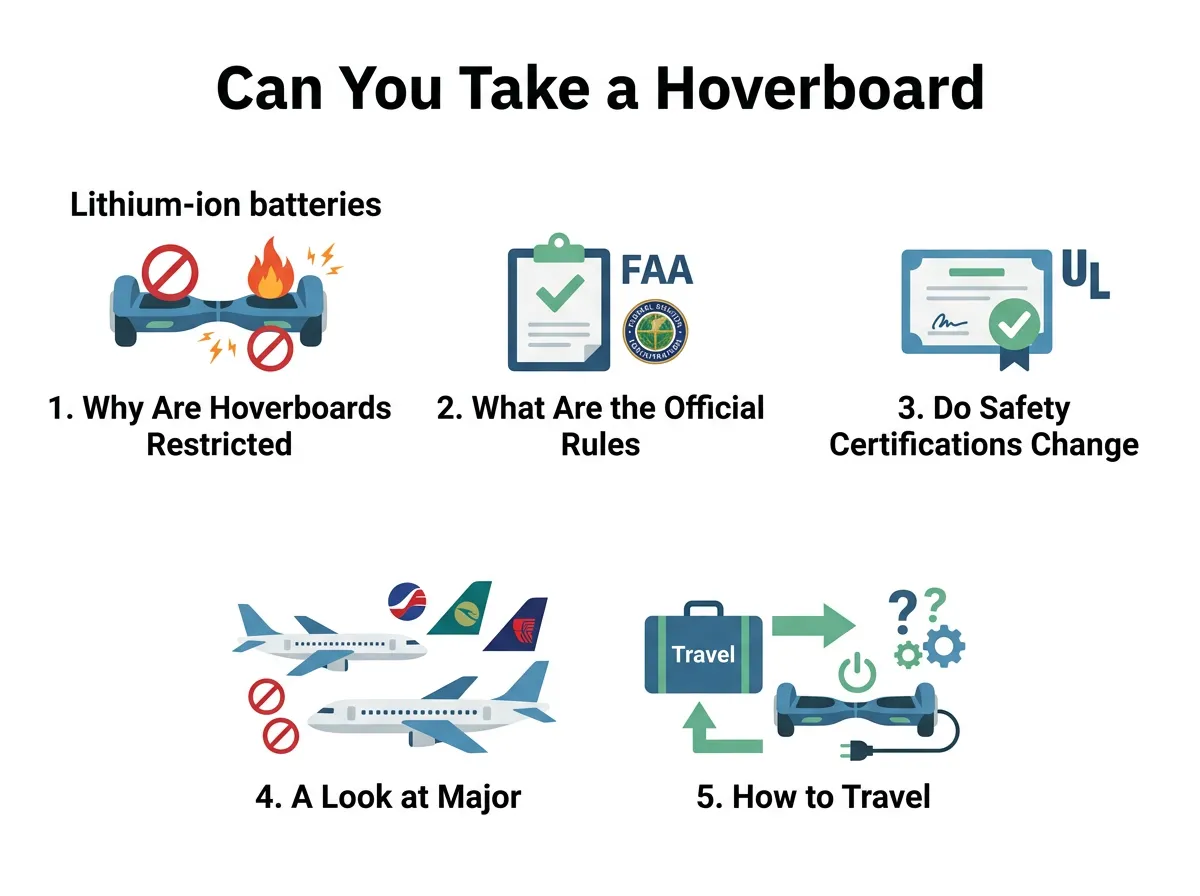
Can You Take a Hoverboard on a Plane? — key points at a glance
The TSA Stance on Hoverboards
The TSA is the group that runs airport security checkpoints. They check your bags and scan your body. Surprisingly, the TSA does not have a flat-out ban on hoverboards. According to their official rules, they leave the choice up to the individual airlines. Many travelers ask the TSA: Can You Take a Hoverboard on a Plane? The TSA officers will check your bag. If they see a hoverboard, they will tell you that you must get permission from your airline. Since almost all airlines say no, the TSA will not let you bring it past the security gate.
Can You Take a Hoverboard on a Plane in Carry-On Bags?
You might think carrying the board with you is safer. After all, if the battery gets hot, the flight crew can put it out. But airlines do not want to take that risk. Most airlines ban hoverboards from the cabin completely. You cannot put them in the overhead bin. You cannot slide them under your seat. They are simply too big and have too much battery power to be safe in the passenger cabin.
Can You Take a Hoverboard on a Plane in Checked Luggage?
What about putting it with the large suitcases? Sadly, this is even more dangerous. If a battery starts a fire in the cargo hold, no one can see it right away. Automated fire systems might not be able to put out a chemical lithium fire. For this reason, checking a hoverboard is strictly forbidden by almost every airline in the world.
Do Safety Certifications Change the Rules?
As you search for answers to “Can You Take a Hoverboard on a Plane?”, you might read about safety stickers. Many modern boards are much safer than the old ones. But does that make them okay to fly?
What is the UL 2272 Certification?
After the fire scare of 2015, safety groups created a new standard. This is called the UL 2272 certification. To get this sticker, a hoverboard must pass tough safety tests. Engineers test the battery, the charger, and the electrical wiring. They drop it, heat it up, and overcharge it to make sure it will not catch fire. If you buy a hoverboard today, you should always look for this UL sticker. It means your board is very safe for home use.
Does UL 2272 Make it Flight-Safe?
You might think an airline would welcome a UL-certified board. Sadly, they do not make exceptions. Gate agents and bag checkers do not have the time to look for stickers. They also cannot verify if a sticker is real or fake. To keep things simple and safe, airlines apply a blanket ban. Even if your board is the safest model on earth, you still cannot fly with it.
A Look at Major Airline Policies
To give you a clear picture, let us look at some specific airlines. Their rules are very clear and strict. If you are asking yourself, Can You Take a Hoverboard on a Plane?, here is what the top carriers say:
- Delta Air Lines: Delta bans all hoverboards. They do not allow them as carry-on bags or as checked luggage. This applies to all flights, both domestic and international.
- United Airlines: United has a strict ban on all smart balance boards. They list them under dangerous goods. You cannot bring them on United planes under any circumstances.
- Southwest Airlines: Southwest does not allow hoverboards. They refuse to accept any device powered by lithium-ion batteries that is used for personal mobility, unless it is a mobility aid like a wheelchair.
- American Airlines: American Airlines bans these boards in both checked bags and carry-on bags. They state that the risk of battery combustion is too high.
- JetBlue: JetBlue does not accept hoverboards. They are listed on their website as prohibited items.
As you can see, the answer to Can You Take a Hoverboard on a Plane? is a clear no across the board. Trying to find a loophole with these major lines will only lead to stress at the gate.
How to Travel with Your Hoverboard Safely
Just because you cannot fly with your board does not mean it has to stay home forever. You still have great options to get your ride to your destination. Here are some smart ways to travel with your hoverboard.
Option 1: Ground Shipping
This is the most popular way to move your board. Companies like UPS, FedEx, and DHL can ship your hoverboard for you. Since they use trucks and trains on the ground, they have different rules than airplanes. You must package the board safely. It is best to use the original box with the foam inserts. You should also tell the shipping company that the package contains a lithium-ion battery. They will put a special sticker on the box and ship it safely by ground.
Option 2: Take a Road Trip
If you are driving to your destination, your hoverboard is welcome to join you. Simply pack it in your car trunk. Make sure it does not sit in direct sunlight on a hot day. Extreme heat can damage the battery. Keep it cool and dry, and you will be ready to ride as soon as you arrive.
Option 3: Rent One at Your Destination
If you are flying to a major tourist spot, you might not need to bring your own board. Many cities have rental shops. You can rent hoverboards, electric scooters, or electric bikes by the hour. This saves you the hassle of packing, shipping, and worrying about your gear.
What Happens if You Try to Sneak It On?
You might be tempted to hide your board in a large suitcase. You might think, “Maybe they won’t notice.” This is a very bad idea. Here is what will happen if you try to sneak a hoverboard onto a plane:
First, airport scanners are very advanced. They can easily see the heavy metal frame, motor, and large battery pack inside your bag. If security finds it in your checked bag, they will open your luggage. They will take the hoverboard out. Your bag will go on the plane, but your board will stay behind. You might not get it back easily.
Second, you could face hefty fines. Bringing banned hazardous items onto a plane is against federal law. You could be fined thousands of dollars. Finally, you could miss your flight. Dealing with security delays can take hours. It is simply not worth the risk.
Conclusion
When planning your next trip, the question of Can You Take a Hoverboard on a Plane? has a very clear answer. Due to safety risks, airlines simply will not allow them. Their lithium-ion batteries are too unstable for air travel. Instead of trying to pack your board, look into ground shipping or rental options. This keeps you safe, avoids airport stress, and ensures a happy, hassle-free trip. Safe travels, and happy riding!
Frequently Asked Questions
Can you take a hoverboard on a plane if you remove the battery?
Yes, in theory, if you completely remove the lithium-ion battery, you can pack the physical frame of the hoverboard. However, the battery itself cannot go on the plane at all, so you would need to buy a new battery at your destination. Make sure to check with your airline first, as some may still reject the frame.
What happens if airport security finds a hoverboard in my bag?
If airport security finds a hoverboard in your luggage, they will not allow it onto the aircraft. You will have to leave it behind, take it back to your car, or give it to someone who is not flying. Attempting to sneak banned items onto a plane can also lead to delays or fines.
Are there any airlines that allow hoverboards?
No, almost all major commercial airlines worldwide have a complete ban on hoverboards. This includes domestic carriers like Delta, United, American, and Southwest, as well as international airlines. Always assume any airline you book with will say no to personal hoverboards.
Why does the UL safety certification not matter to airlines?
Airlines enforce blanket bans because airport staff do not have the time to check and verify safety stickers on individual devices. It is much safer and faster for the airlines to ban all self-balancing boards regardless of their certification. Therefore, your UL 2272 sticker will not help you get the board onto a flight.
Can I ship my hoverboard through the mail instead?
Yes, you can easily ship your hoverboard using ground shipping services like UPS, FedEx, or DHL. Because ground shipping relies on trucks and trains, they can safely transport lithium-ion batteries. Just make sure to pack it securely and declare the battery when you print your shipping label.
Can you take other electric rideables like skateboards or scooters on a plane?
Most electric skateboards and scooters face the same strict limits as hoverboards because of their large batteries. However, some very small electric skateboards with batteries under 100 watt-hours may be allowed as carry-ons by specific airlines. You must check the exact watt-hour rating of your device and get approval from your airline before your flight.
