


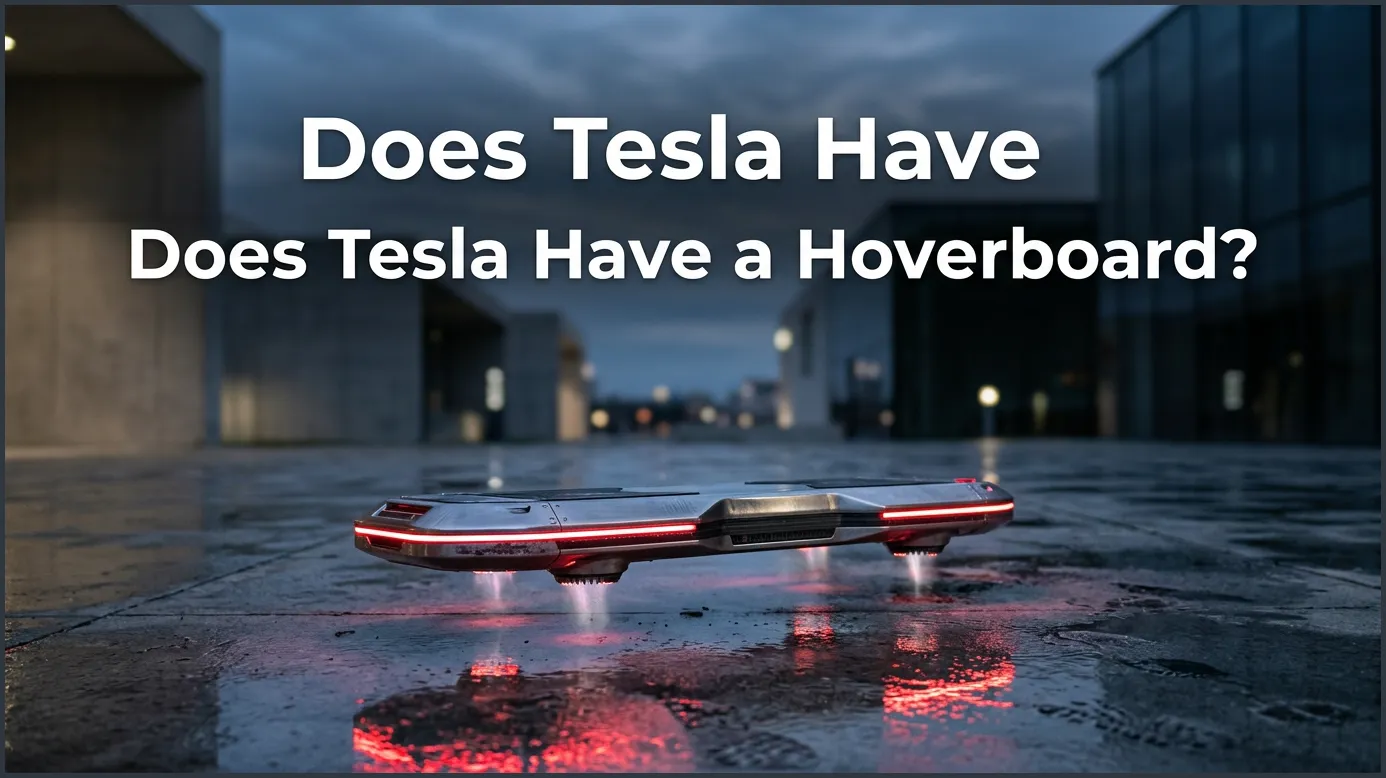
Tesla does not have a hoverboard. Any videos or photos you see online showing a Tesla-branded hoverboard are clever concept designs or digital hoaxes. While Elon Musk loves futuristic technology, the company remains focused on electric cars, trucks, and robotics rather than floating skateboards.
Imagine gliding smoothly above the hard pavement. No wheels. No bumps. No friction at all. For decades, we have dreamed of this future. Movies like Back to the Future showed us what life could look like with floating boards. Now, as technology leaps forward, people wonder if we are finally there. Whenever a new, wild piece of tech pops up, one name always comes to mind. That name is Tesla.
If you spend any time on social media, you have probably seen the clips. Beautiful, metallic boards with glowing lights float effortlessly in the air. They wear the iconic Tesla logo. They look sleek and completely real. These clips make everyone ask the same big question: Does Tesla Have a Hoverboard? Let us separate the myths from the facts.
In this guide, we will explore the truth about these viral clips. We will look at how the rumors started. We will also dive into the real science of levitation. Finally, we will see what Tesla is actually building for the future.
Key Takeaways
- No Active Product: Tesla does not manufacture or sell any kind of hoverboard.
- Viral Videos are Fake: Popular clips showing a floating Tesla board are CGI concepts made by independent designers.
- Science Limitations: True levitation requires magnets and special tracks, making open-road hoverboards impractical today.
- Musk’s Focus: Elon Musk is focused on sustainable transport, space travel, and robotics over personal toys.
- Great Alternatives Exist: If you want a similar feeling, electric skateboards and Onewheels are available now.
📑 Table of Contents
The Origin of the Tesla Hoverboard Myth
To understand the rumors, we have to look back a few years. A gorgeous video started to spread across the internet. It showed a silver board floating a few inches off the ground. The board had the signature Tesla look. It matched the design of their high-end cars. It looked like a product you could buy tomorrow.
People on social media went crazy. The video got millions of views. Many users assumed Elon Musk had done it again. They thought he had quietly built a revolutionary new ride. But there was a catch. The board was not real. It was a digital model.
A talented 3D artist named Tomislav Bezinsky created the video. He wanted to show his vision of what a future ride could look like. It was a fan-made art project. If you read the Fast Company report on the Tesla hoverboard concept, you will see it was just a beautiful dream. No physical board was ever built by Tesla. The company had nothing to do with the video. This clears up the confusion for anyone asking: Does Tesla Have a Hoverboard?
Why Viral Videos Fool Us So Easily
Why do so many of us believe these videos? It is because we want them to be real. Tesla has a reputation for turning science fiction into reality. They made electric cars fast and cool. They land rockets back on earth. They are even building a robot that can do chores. With all of that success, a floating board seems like a simple next step.
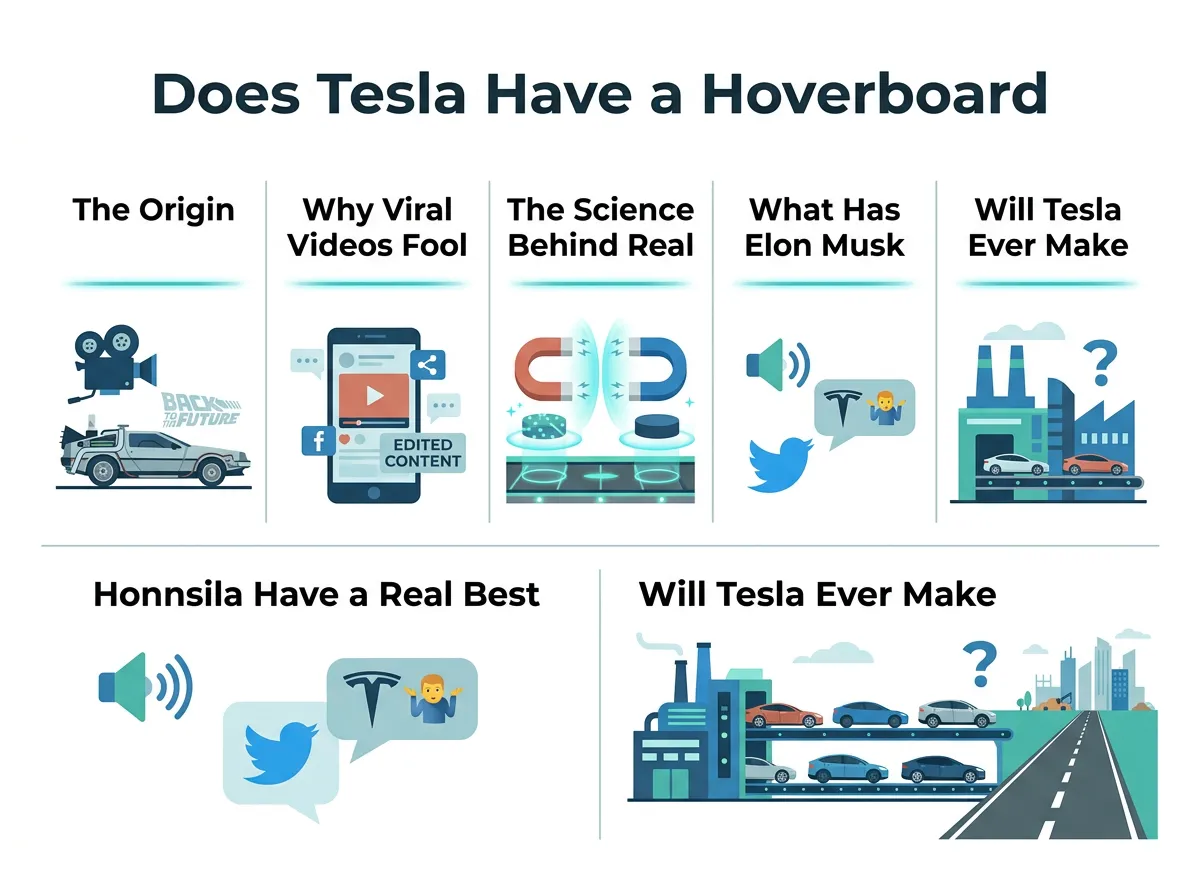
Does Tesla Have a Hoverboard? — key points at a glance
The Power of Modern CGI
Computer-generated imagery, or CGI, is incredibly advanced now. You do not need a giant movie studio to make a convincing video. A skilled artist with a good computer can create amazing things. They can add realistic shadows, reflections, and dust particles. When they place a floating board in a real-world setting, our eyes believe it. Our brains see the Tesla logo and connect the dots.
The Clickbait Loop
Social media sites run on views and shares. Creators know that using popular names gets attention. Putting the word “Tesla” next to “hoverboard” is a recipe for viral success. Even when a creator says the video is just a concept, that detail gets lost. People share the video without reading the description. Soon, thousands of people are asking: Does Tesla Have a Hoverboard? The rumor spreads faster than the truth.
The Science Behind Real Hoverboards
Can we actually make things hover in real life? Yes, we can. But the science is very hard. It is not as simple as putting a battery inside a wooden board. Real levitation requires very specific conditions.
Magnetic Levitation (Maglev)
You have probably heard of Maglev trains. These trains use powerful magnets to float above their tracks. Because they do not touch the tracks, they go very fast. A company named Hendo once built a working hoverboard using this tech. It actually floated! However, it could only float over a copper surface. On normal concrete or dirt, it did not work. It was also very loud and had a short battery life.
Superconductors and Liquid Nitrogen
The car brand Lexus also built a real hoverboard. They used superconductors cooled by liquid nitrogen. It looked like magic. White steam rolled off the sides of the board. But just like the Hendo board, it had a catch. It required a special track with magnets hidden under the ground. You could not ride it down a normal street. The board was also very expensive to build and maintain.
What Has Elon Musk Said About Levitation?
Elon Musk is the head of Tesla. He is famous for his wild ideas. He has actually talked about floating technology before. But his ideas are a bit different from what you might expect.
The Roadster and Rocket Thrusters
A few years ago, Musk made a surprising claim. He said the upcoming Tesla Roadster might hover. He explained that they could use cold-gas thrusters. These are small rocket engines that use compressed air. In theory, these thrusters could push the car off the ground. But this is still a car, not a personal skateboard. It would also be very loud. Imagine the noise of a jet engine on a quiet city street!
The Problem with Leaf Blowers
Musk has also pointed out the issues with air-based hoverboards. To lift a human, you need to push a lot of air downward. This requires massive fans. It would be like standing on top of several high-powered leaf blowers. It would create a huge storm of dust and dirt. It would also use up a battery in just a few minutes. For these reasons, Musk does not see personal hoverboards as a practical way to travel.
Will Tesla Ever Make a Hoverboard?
We know that the current answer to “Does Tesla Have a Hoverboard?” is a clear no. But could that change? Will Tesla ever build one in the future? It is highly unlikely.
A Focus on Big Problems
Tesla has a very clear mission. They want to speed up the world’s transition to clean energy. They do this by building electric cars, semi-trucks, solar panels, and large batteries. They are also working on self-driving technology and humanoid robots. These are massive projects. They require billions of dollars and years of work. A hoverboard is a fun toy, but it does not help Tesla solve global energy problems.
Safety and Laws
Safety is another major issue. Floating boards are very hard to control. Without wheels on the ground, you cannot steer or stop easily. A strong gust of wind could blow a rider into traffic. No government would allow these boards on public roads or sidewalks. Tesla would face massive legal issues if they sold a product that was so dangerous. They prefer to stick to vehicles with four wheels and safety belts.
Fun Alternatives You Can Buy Today
You cannot buy a Tesla hoverboard today. But you do not have to give up on your dreams of a futuristic ride. There are some amazing electric rides available right now that feel incredibly smooth.
Electric Skateboards
Electric skateboards are incredibly popular. Brands like Boosted and Meepo make fast, reliable boards. You hold a small remote in your hand to control your speed. When you ride a high-quality electric board, it feels like you are surfing on land. The ride is quiet, fast, and very smooth.
The Onewheel
The Onewheel is a unique ride. It has one large wheel right in the middle of the board. It uses self-balancing technology to keep you upright. You lean forward to go, and lean back to slow down. Many riders say the Onewheel is the closest thing to a real hoverboard. It can go over grass, dirt, and gravel. It gives you a true feeling of floating.
Standard Hoverboards
We also have the two-wheeled self-balancing scooters that everyone calls “hoverboards.” These do not actually hover. They have wheels that touch the ground. But they are still very fun to ride. They are great for kids and are very easy to learn. They are also much cheaper than electric skateboards.
Conclusion
To wrap things up, does Tesla have a hoverboard? No, they do not. The beautiful videos and photos we see online are the work of talented digital artists. While true floating technology exists, it is not ready for our streets. It requires special magnetic tracks or loud thrusters. Tesla is busy building the future of cars and robots. But do not let that get you down. With electric skateboards and Onewheels, we can still enjoy the thrill of the ride today.
Frequently Asked Questions
Does Tesla sell a hoverboard?
No, Tesla does not sell a hoverboard. Any Tesla-branded hoverboards you see online are fan-made digital concepts or hoaxes.
Why are there videos of a Tesla hoverboard?
These videos are created using advanced 3D computer graphics (CGI). Digital artists design these concepts to show what a future Tesla product might look like.
Has Elon Musk talked about hoverboards?
Elon Musk has discussed levitation tech but thinks air-based hoverboards are too loud and impractical. He prefers focusing on electric cars and rockets.
Can you buy a real hoverboard?
True hoverboards that float in the air exist as prototypes, but they only work on special magnetic tracks. You cannot buy a practical hoverboard for normal streets.
What is the closest thing to a real hoverboard?
The Onewheel and electric skateboards are the closest alternatives. They offer a smooth, carving motion that feels very similar to floating.
Will Tesla make a hoverboard in the future?
It is very unlikely. Tesla is focused on larger projects like electric vehicles, solar energy, and robotics rather than personal toys.
