


Most standard hoverboards travel at speeds between 6 and 10 miles per hour (mph). High-performance, off-road models can reach top speeds of 12 to 15 mph, while kids’ hoverboards are limited to a safer speed of around 5 mph. Your actual speed will vary based on your weight, the terrain, and your battery life.
Imagine stepping onto a sleek, self-balancing board for the very first time. You gently lean your body forward, and the machine instantly glides across the pavement. It feels like you are floating a few inches off the ground. This thrilling sensation is why self-balancing scooters have captured the hearts of people all over the world.
When you look at buying one of these devices, you likely want to know about its performance. You might wonder how quickly you can travel to work, school, or the local park. Understanding the velocity of these boards helps you plan your rides and stay safe on the road. It also ensures you buy the perfect model for your specific needs.
In this guide, we will look at all the factors that control your velocity. We will break down different types of boards, look at real-world speed factors, and share essential safety tips. Let us dive in and explore the exciting world of personal electric travel.
Key Takeaways
- Average Speed: Most classic hoverboards run at speeds of 6 to 10 mph.
- Kids’ Speed Limits: Children’s boards have safety features that limit speeds to 5 mph.
- Terrain Impacts Performance: Smooth asphalt allows for maximum speed, while grass and hills slow you down.
- Weight Matters: Heavier riders will experience slightly slower top speeds and faster battery drain.
- Safety Warning Beeps: Hoverboards emit an alert sound when you approach their maximum speed limit.
- All-Terrain Power: Off-road hoverboards have larger motors and can go up to 12 or 15 mph.
📑 Table of Contents
Understanding Average Hoverboard Speeds
Not all self-balancing boards are built the same way. Manufacturers design different models for different users, which means they do not all move at the same pace. When asking about limits, we must look at the specific category of the board. According to comprehensive hoverboard speed guides, most everyday hoverboards offer a balanced pace that fits typical suburban and urban paths.
Kids’ Hoverboards
Safety is the number one priority for children’s toys. For this reason, kids’ boards are built with smaller motors and strict limiters. These models usually top out at a gentle 5 miles per hour. This velocity is fast enough to be highly entertaining for a young child, yet slow enough for a parent to easily jog alongside them.
Standard Hoverboards
Standard boards are built for older teenagers and adults. These are the models you see most often in neighborhoods and public parks. They feature tire sizes of 6.5 inches to 8 inches. A standard model typically travels between 6 and 10 miles per hour. This pace is perfect for smooth sidewalks and flat streets.
Off-Road and All-Terrain Hoverboards
If you want more adventure, you will need a heavy-duty model. Off-road hoverboards come with massive, knobby tires that are 8.5 inches or larger. They have dual motors with high wattage. These rugged machines can easily reach speeds between 12 and 15 miles per hour. If you want extreme speed, you can view the fastest high-performance hoverboards currently available.
Key Factors That Impact Your Speed
The number printed on the hoverboard box is the maximum speed achieved under perfect test conditions. In the real world, your actual velocity will fluctuate. Several everyday variables will change how fast you can glide down your street.
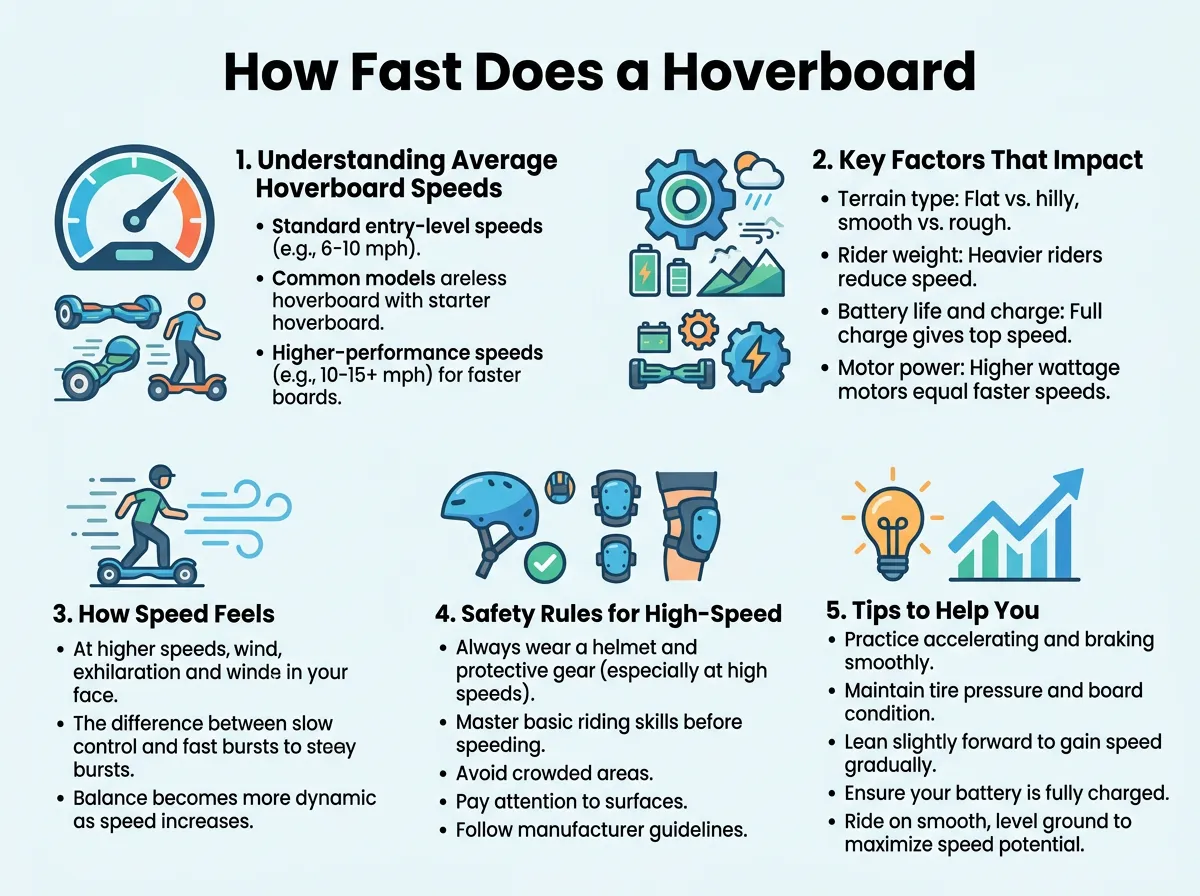
How Fast Does a Hoverboard Go? — key points at a glance
Rider Weight
The motor has to work harder to push more weight. If a rider is close to the board’s maximum weight limit, the motor will struggle to reach its top velocity. Lighter riders will find it much easier to hit those high speeds quickly. Always check the weight capacity of your board before you buy it.
Battery Life and Charge
Your board relies on a lithium-ion battery. When your battery is fully charged, it supplies maximum voltage to the motors. As the battery drains, the voltage drops. You will notice that your board feels a bit slower when the battery indicator light starts flashing yellow or red.
The Terrain You Ride On
Where you ride plays a massive role in your overall velocity. Flat, smooth concrete is the ideal surface for speed. If you try to ride through thick grass, loose gravel, or up a steep hill, your board has to fight extra resistance. This resistance slows you down and drains your battery much faster.
How Speed Feels on a Hoverboard
Ten miles per hour might not sound very fast when you are sitting inside a car. However, standing on a small, moving platform is a completely different story. Many users discuss this on community forums, with several riders sharing their experiences on Quora about how fast they can safely ride.
The Perception of Speed
When you stand on a hoverboard, your feet are just a few inches off the ground. You have no windshield, doors, or seatbelts. This open-air stance makes even 8 miles per hour feel incredibly fast. It feels much faster than riding a bicycle at the same pace because you rely entirely on your core muscles to stay upright.
Maintaining Your Balance
At low speeds, making small balance adjustments is simple. If you hit a tiny bump at 3 miles per hour, your ankles can absorb the shock easily. At 10 or 12 miles per hour, a tiny crack in the pavement can cause you to lose your balance. That is why staying alert and keeping a relaxed, slightly bent knee posture is crucial when riding fast.
Safety Rules for High-Speed Riding
Riding fast is highly enjoyable, but it does come with risk. You must take steps to protect yourself from falls. Understanding how your board communicates speed limits is the first step toward staying safe.
Listen to the Warning Beeps
Most quality boards have built-in safety alarms. When you approach the maximum safe velocity of the motor, the board will start to beep rapidly. This sound is a clear warning to slow down. If you ignore the beep and keep leaning forward, the board may tilt back automatically or shut off to protect the motor, which can cause a fall.
Wear the Right Gear
Never step onto a self-balancing board without safety gear, no matter how skilled you are. A proper helmet is a non-negotiable requirement. You should also wear wrist guards, elbow pads, and knee pads. If you do happen to lose your balance at 10 miles per hour, this gear will protect you from scrapes and broken bones.
Tips to Help You Ride Safely and Efficiently
If you want to get the best performance and velocity out of your machine, you should follow a few simple maintenance tips. A well-kept board is always faster and safer than a neglected one.
- Calibrate Your Board: If your board feels shaky or unresponsive, it might be out of calibration. Turn the board off, place it on a perfectly flat surface, and hold the power button down for ten seconds until the lights flash. This resets the gyroscopes.
- Keep Tires Inflated: If your board has pneumatic (air-filled) tires, make sure they are inflated to the recommended pressure. Low tire pressure increases friction and slows you down.
- Charge Properly: Avoid riding your board immediately after charging. Let the battery cool down for fifteen minutes. Never leave your board on the charger overnight, as this can degrade battery performance over time.
Conclusion: Finding Your Speed Zone
So, how fast does a hoverboard go? For most riders, the sweet spot lies between 6 and 10 miles per hour. This pace gives you a thrilling, breezy ride while keeping you in complete control. If you are buying for a young child, stick to a limited model that keeps them safe. If you are an experienced outdoor adventurer, look for an all-terrain board that can handle higher speeds on rough ground. Always wear your safety gear, respect the warning beeps, and enjoy the ride!
Frequently Asked Questions
How fast does a standard hoverboard go?
Most standard hoverboards for teenagers and adults go between 6 and 10 miles per hour. This speed is perfect for flat surfaces, neighborhood sidewalks, and paved park paths.
Are there hoverboards that can go 15 mph?
Yes, heavy-duty off-road and all-terrain hoverboards can reach speeds of 12 to 15 miles per hour. These models feature larger motors, rugged tires, and stronger batteries to handle the extra speed.
Why does my hoverboard beep when I go fast?
The beep is a built-in safety warning showing that you are reaching the board’s maximum speed limit. You should lean back slightly to slow down immediately when you hear this alarm.
Does rider weight affect the speed of a hoverboard?
Yes, heavier riders require more power from the electric motors to move forward. If a rider is close to the maximum weight limit, the board will have a slightly lower top speed and slower acceleration.
What is the safest speed for a child on a hoverboard?
The safest speed for young children is around 5 miles per hour. Most kids’ hoverboards have built-in speed limiters to prevent them from going too fast and losing their balance.
Can a hoverboard go fast on grass or gravel?
Hoverboards will run much slower on grass, gravel, and dirt due to the high rolling resistance. Only off-road models with large, specialized tires can maintain decent speeds on these rough surfaces.
