


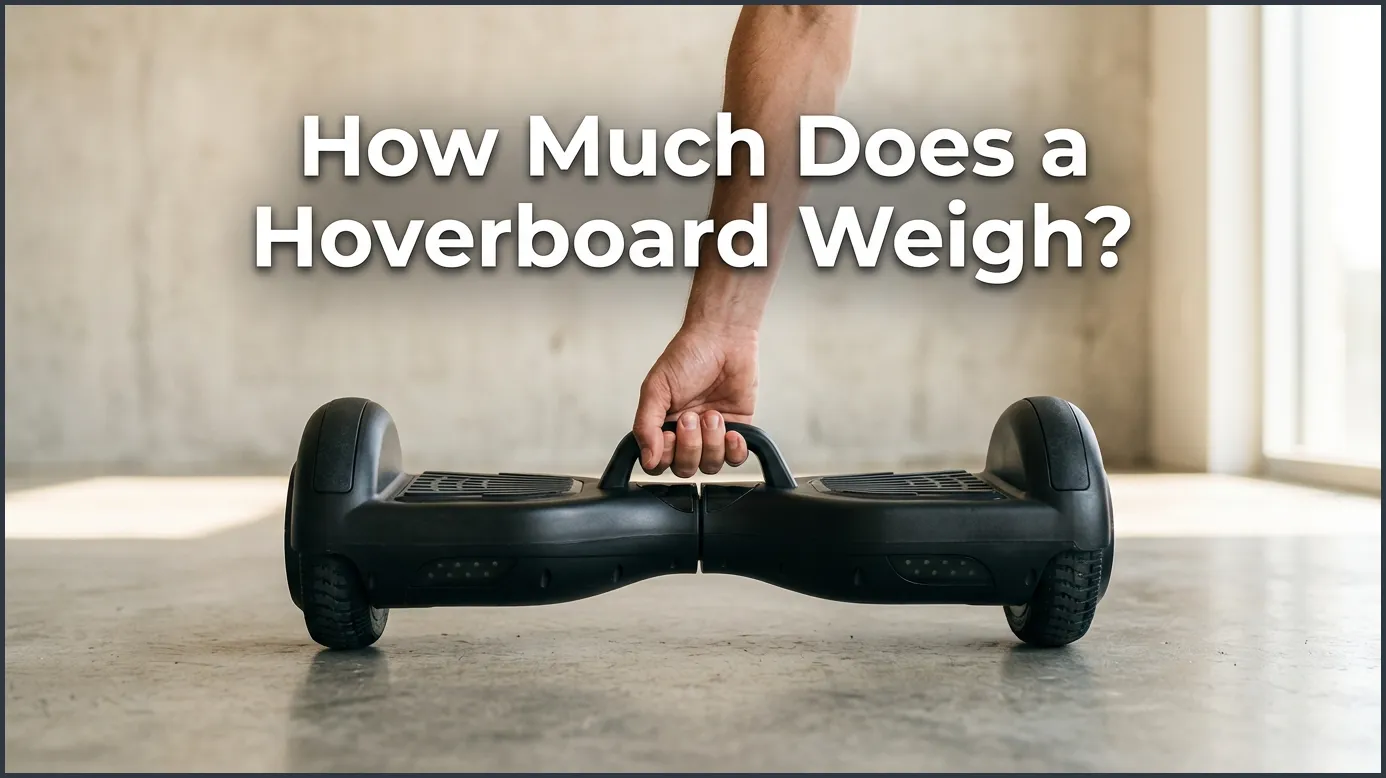
Most standard hoverboards weigh between 20 and 30 pounds (9 to 14 kg), depending on their wheel size, battery capacity, and build materials. Off-road models with larger tires are heavier, while smaller kids’ models are much lighter and easier to carry. Knowing these differences helps you choose a device that is easy to transport when the battery runs out.
Imagine this scenario. You are cruising down the street on your shiny new self-balancing scooter. The wind is in your hair, and you feel like you are flying. Suddenly, the battery light flashes red, and the motor cuts out. You are a mile away from home. You bend down, pick up your board, and start walking. Within five minutes, your arm is aching, your shoulder is sore, and you are wondering why this sleek little device feels like a block of solid lead.
Many new riders overlook the physical weight of their ride until they actually have to carry it. Knowing how much does a hoverboard weigh is crucial before making a purchase. It affects everything from how easily you can transport it to how it performs on the road. If you are asking yourself how much does a hoverboard weigh before you buy, you are already one step ahead of most shoppers.
In this comprehensive guide, we will break down the average weights of different hoverboard types. We will also explore the key factors that add to their heft and help you decide which weight class is best for your daily lifestyle.
Key Takeaways
- Wheel size is key: Wheel size is the primary factor determining a hoverboard’s overall weight.
- Standard weight: Standard 6.5-inch hoverboards usually weigh around 20 to 22 pounds.
- Off-road weight: Off-road and 10-inch models can weigh up to 30 pounds or more due to heavy-duty frames.
- Stability trade-off: Heavier hoverboards often provide better stability but are harder to carry.
- Capacity difference: There is a big difference between how much a hoverboard weighs and its rider weight capacity.
📑 Table of Contents
Average Hoverboard Weights by Type
When shopping around, you will quickly notice that these self-balancing boards come in many shapes and sizes. The weight of a hoverboard is closely tied to its intended use and wheel size. Let’s look at the three main categories you will find on the market today.
Standard Hoverboards (6.5-inch wheels)
These are the most common models. They are designed for flat pavement and smooth indoor surfaces. Because they have smaller motors and compact frames, they are the lightest option for teens and adults. On average, a standard hoverboard weighs about 18 to 22 pounds (8 to 10 kg). For a complete breakdown of these measurements, you can consult this helpful hoverboard weight guide in pounds.
Off-Road Hoverboards (8.5-inch wheels)
If you want to ride on grass, gravel, or dirt, you need an off-road model. These boards feature larger, rugged tires and stronger motors to handle tough terrain. To support this extra power, they require a sturdier metal frame. As a result, off-road hoverboards usually weigh between 24 and 28 pounds (11 to 13 kg).
Heavy-Duty Hoverboards (10-inch wheels)
These are the giants of the hoverboard world. They feature pneumatic (air-filled) tires that measure 10 inches in diameter. They offer the smoothest ride possible over bumps and cracks. However, those large tires and beefy frames come with a trade-off. These heavy-duty models often weigh 30 pounds (14 kg) or more.
Why Does Hoverboard Weight Matter?
You might think that weight only matters when the battery dies. But the truth is, weight impacts your entire riding experience. It affects how you interact with your board every single day.
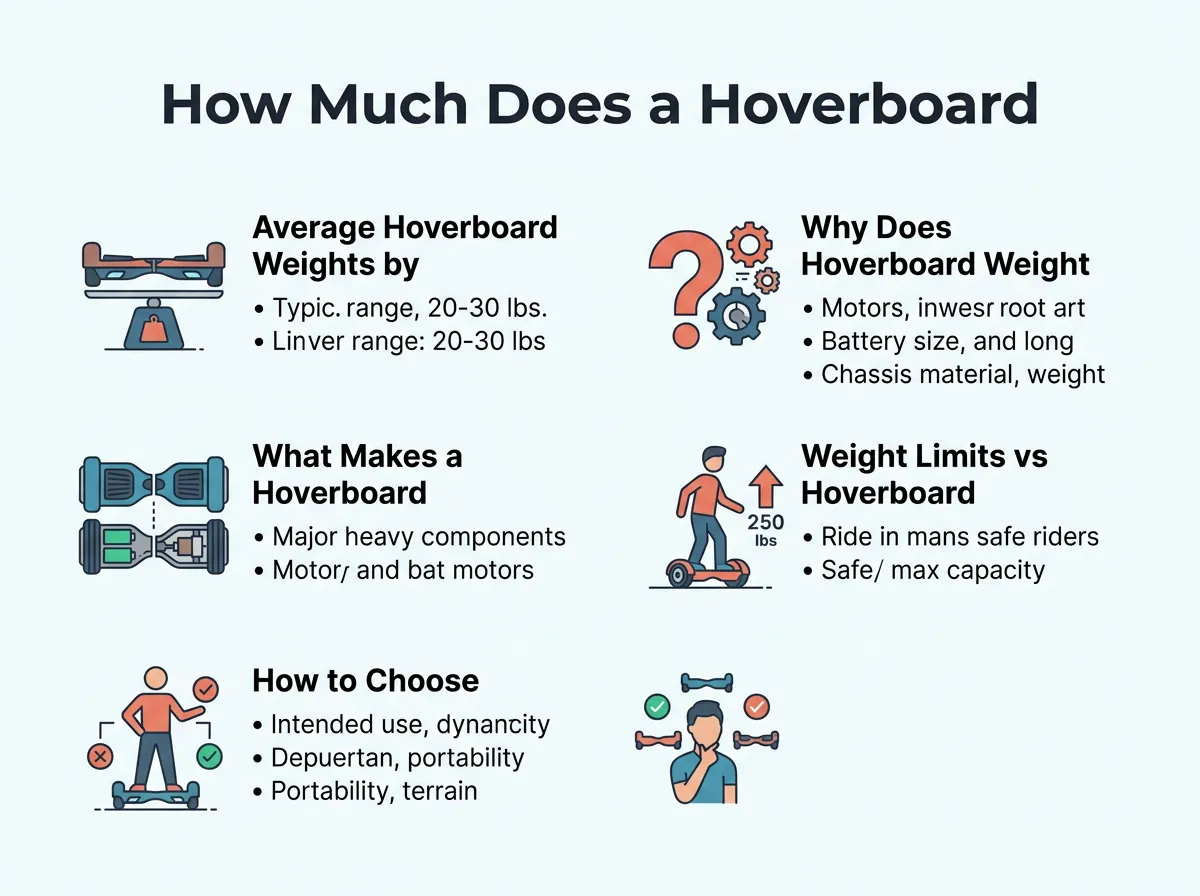
How Much Does a Hoverboard Weigh? — key points at a glance
Portability and Carrying Comfort
Unless you only ride in your driveway, you will eventually have to carry your board. You might need to take it up a flight of stairs, carry it onto a bus, or pack it into a car trunk. Carrying a 20-pound board is manageable for most adults, but a 30-pound board can quickly become exhausting. If you have to carry it for more than a few minutes, every extra pound feels twice as heavy.
Battery Life and Range
Just like in cars, a heavier vehicle requires more energy to move. A heavy hoverboard puts more strain on the battery. If two boards have the exact same battery but different weights, the lighter board will usually travel further on a single charge. If you want a longer range, a lighter board can sometimes be the smarter choice.
Speed and Maneuverability
The weight of your board affects how it handles. Lighter boards are quick, agile, and easy to turn. They react fast to your body movements. Heavier boards feel more stable and grounded, but they require more effort to turn quickly. To understand how these dynamics play out during your rides, read more about the impact of hoverboard weight on performance.
What Makes a Hoverboard Heavy? (The Main Components)
Why do these machines weigh so much in the first place? To the naked eye, they just look like a plastic platform with two wheels. But inside, they are packed with heavy-duty technology that adds to the total weight.
The Electric Motors
Hoverboards do not just have one motor; they have two. Each wheel is powered by its own hub motor hidden inside the wheel rim. These motors contain heavy copper coils and powerful magnets. The stronger the motor, the heavier it is. High-speed boards need bigger motors, which adds to the overall weight.
The Lithium-Ion Battery
The battery pack is the heart of your hoverboard. It consists of multiple lithium-ion cells packed tightly together. High-capacity batteries that allow you to ride for hours are naturally much heavier than smaller, low-capacity ones. If you want more battery power, you must accept a heavier board.
The Frame and Outer Shell
Cheap hoverboards might use cheap plastic frames, but quality boards use strong aluminum or steel. This metal skeleton ensures the board does not snap in half when you ride it. The outer plastic shell also adds a few pounds to protect the delicate internal electronics from water and dust.
Wheel and Tire Size
Rubber is heavy. Heavy-duty rubber tires, especially those with thick off-road treads or metal rims, add significant weight to the outer edges of the board. Larger wheels mean more rubber and metal, which is why off-road boards are always heavier.
Weight Limits vs. Hoverboard Weight
There is often a lot of confusion between how much does a hoverboard weigh and how much weight it can carry. These are two very different metrics, but they are closely related.
Understanding Carrying Capacity
Every hoverboard has a maximum weight limit. This is the maximum weight of the rider that the board can safely support without damaging the motors or frame. Most standard boards can support up to 220 pounds (100 kg), while heavy-duty models can support up to 265 pounds (120 kg) or more. For safety reasons, you should always check the manufacturer’s guidelines regarding rider weight limits for hoverboards before buying.
Finding the Sweet Spot for Kids and Adults
If a child rides a hoverboard that is too heavy, they might not weigh enough to trigger the pressure sensors under the footpads. This can make the board shake or act erratically. Conversely, if an adult rides a board that is too light and lacks a high weight capacity, the motors will overheat and the battery will drain rapidly. You must match the rider’s weight to both the board’s capacity and the board’s physical weight.
How to Choose the Right Hoverboard Weight for Your Needs
Choosing the right weight depends entirely on who is riding and where they plan to ride. Here is a quick guide to help you find your perfect match.
Best Weights for Young Kids
For children aged 5 to 10, look for lightweight models that weigh between 15 and 18 pounds. These boards usually have smaller 4.5-inch or 6.5-inch wheels. They are easy for kids to carry around the yard and react well to lighter body weights without requiring too much physical effort to control.
Best Weights for Daily Commuters
If you plan to use your hoverboard for school or work, portability is key. Look for a standard 6.5-inch board weighing around 20 to 22 pounds. This weight gives you a great balance of speed, battery life, and ease of carrying. It is light enough to carry onto a bus or up a flight of stairs without hurting your arm.
Best Weights for Off-Road Adventurers
If you want to tackle trails, grass, and rough terrain, do not worry too much about the heavy weight. An 8.5-inch or 10-inch board weighing 25 to 30 pounds is necessary for these rough environments. The extra weight gives you the traction, stability, and durability needed for outdoor fun.
Practical Tips for Carrying a Heavy Hoverboard
If you do end up buying a heavier board, do not panic! You do not have to develop giant arm muscles just to enjoy your ride. Here are some smart ways to make carrying your board much easier.
Invest in a Hoverboard Backpack
A dedicated hoverboard backpack is a game-changer. These bags are custom-shaped to fit your board perfectly. By wearing it like a backpack, you distribute the weight evenly across both shoulders. This makes even a 30-pound board feel relatively light and keeps your hands completely free.
Use a Carrying Strap
If you do not want a full backpack, a simple shoulder strap is a great alternative. These straps clip onto the wheels or middle axle of your board. They allow you to carry the board over your shoulder like a duffel bag, which is much easier than carrying it by the center handle.
Keep Track of Your Battery
The easiest way to avoid carrying a heavy board is to make sure it never dies on you. Always check your battery indicator before heading out on a long ride. Try to plan your routes so you are never too far from a charger when the power starts running low. Prevention is the best medicine!
Conclusion
So, how much does a hoverboard weigh? On average, you can expect your ride to weigh anywhere from 18 to 30 pounds. The right weight for you depends on how you plan to use it. If you want something easy to carry on your daily commute, a lighter 6.5-inch board is your best bet. If you want to conquer rough trails, a heavier off-road model is worth the extra muscle power. By understanding your options and planning ahead with smart carrying accessories, you can enjoy all the fun of hoverboarding without any of the heavy lifting.
Frequently Asked Questions
Can kids carry a standard hoverboard?
Most standard hoverboards weigh around 20 pounds, which can be heavy for younger children to carry for long periods. For kids under 10, it is best to look for specially designed lightweight models that weigh under 15 pounds. Parents should also consider buying a carrying backpack to make transport easier for children.
Why are off-road hoverboards heavier than standard ones?
Off-road hoverboards are heavier because they require more heavy-duty components to handle rough terrain. They feature larger rubber tires, stronger electric motors, and a reinforced aluminum or steel frame. These added materials increase the durability of the board but also increase its overall weight to 25 pounds or more.
Does a heavier hoverboard go faster?
Not necessarily. While heavier hoverboards often have larger, more powerful motors, they also require more energy to move the extra weight. Speed is determined by motor wattage and battery voltage rather than the physical weight of the board itself. Many lightweight boards can go just as fast as heavier models on flat ground.
How does hoverboard weight affect battery life?
A heavier hoverboard places a larger load on the motors, which causes them to draw more power from the battery. If two hoverboards use the exact same battery pack, the lighter model will typically offer a longer riding range. To maintain a good battery range, heavier boards must use larger, heavier batteries, which adds even more weight.
Can I get a carrying bag for any hoverboard size?
Yes, carrying bags and backpacks are available for all standard hoverboard sizes, including 6.5-inch, 8.5-inch, and 10-inch models. When shopping for a bag, make sure to check the product descriptions to ensure it is compatible with your specific wheel size. A well-fitting bag prevents the board from sliding around while you walk.
What is the lightest hoverboard available?
The lightest hoverboards on the market are designed specifically for young children and usually weigh between 12 and 14 pounds. These models feature smaller 4.5-inch wheels and plastic frames with low-capacity batteries. While highly portable, they have much lower rider weight limits and are not suitable for adults.
