


While true sci-fi style hoverboards do not exist for public streets yet, we have very close prototypes that use magnets or air propulsion. A real, mainstream hoverboard that floats anywhere is still decades away due to massive energy and physics limits. For now, we must rely on wheeled “hoverboards” or specialized magnetic tracks to get our floating fix.
Do you remember the first time you saw a movie character glide effortlessly above the ground? The board did not have wheels. It did not touch the grass. It just floated in the air. For many of us, that moment sparked a lifelong dream. We wanted to hop on a board, kick off the ground, and fly over streets, puddles, and hills. It looked so easy, so quiet, and so fun.
Decades have passed since those movies came out. We now have electric cars, smart watches, and phones that can talk to us. Yet, our feet are still firmly on the ground when we travel. We still walk, run, and roll. We often look at our modern world and ask ourselves a simple question: When Will We Get Hoverboards? It feels like the future is taking its sweet time to arrive.
In this guide, we will look at the real science of floating. We will explore the cool boards people have already built. We will also look at the massive hurdles in our way. Finally, we will give you a realistic timeline for when you might actually buy one for yourself.
Key Takeaways
- Magnetic levitation: This technology works well but requires special metal tracks beneath the board.
- Power limits: Battery technology is currently too heavy to lift itself and a rider for very long.
- Air thrust: Jet-powered boards exist today, but they are loud, dangerous, and very expensive.
- Superconductors: True floating boards need extreme cold temperatures to work with magnets.
- Timeline: Realistic, affordable hoverboards for everyday use are likely still decades away.
📑 Table of Contents
What is a True Hoverboard?
Before we dive into the science, we need to define what we are talking about. There is a big difference between a toy you buy at the store and the dream we see in movies.
The Sci-Fi Dream vs. Reality
In science fiction, a hoverboard is a small, light deck. It looks like a skateboard without wheels. It can float a few inches off the ground. It works over any surface, like concrete, grass, or water. It does not make loud noises. It does not blow hot air. It just defies gravity. In the real world, defying gravity is very, very hard to do.
Why the Wheeled Versions Do Not Count
You have probably seen kids riding two-wheeled self-balancing scooters. Stores call these hoverboards. But let us be honest: they do not hover. They use rubber tires to roll on the ground. They are fun toys, but they do not float. They do not fulfill our dream of flying. A true hoverboard must have air space beneath it at all times.
The Science of Making Things Float
To make a heavy object float, we have to fight gravity. Gravity is the force that pulls everything down to Earth. To fight it, we need an equal or greater force pushing up. Scientists use three main ways to try to do this.
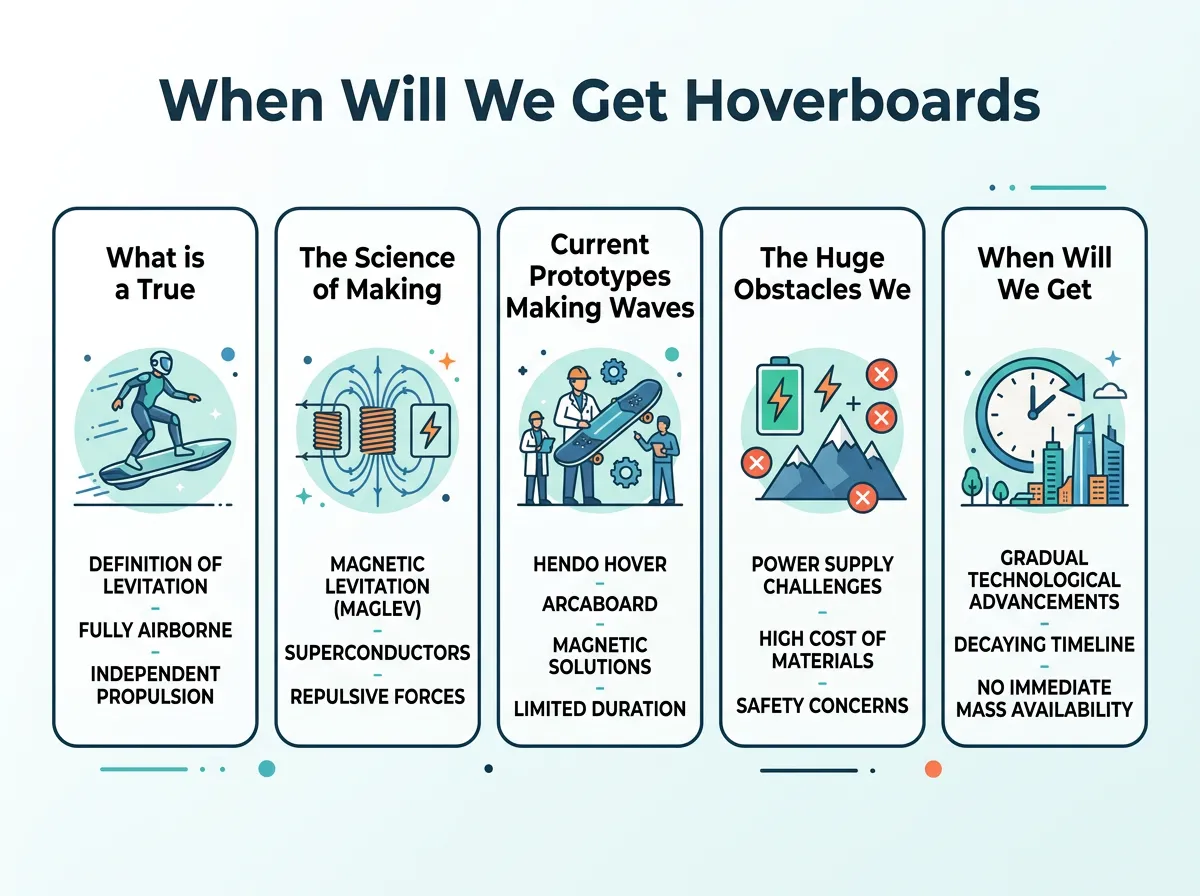
When Will We Get Hoverboards? — key points at a glance
Magnetic Levitation (Maglev)
Magnets are very strong. If you take two magnets and push the same poles together, they will repel each other. They push apart with great force. This is how high-speed trains float above tracks. This is called maglev. It is quiet and smooth. But there is a huge catch. It only works over magnetic surfaces. A maglev board will not float over normal dirt, wood, or asphalt.
Air Thrust and Propulsion
This method works like a helicopter. If you push enough air down, you go up. Some inventors use small jet engines or high-speed fans. These engines create a massive downward force. They can lift a heavy person high into the air. But they are incredibly loud. They also blow hot air and dust everywhere. They are not something you could safely ride on a busy sidewalk.
Quantum Locking and Superconductors
This is the closest thing to real magic. Superconductors are special materials that conduct electricity with zero resistance. When they get very cold, they push away magnetic fields. If you place a cold superconductor over a magnet, it locks in place in mid-air. It can float and glide with zero friction. But it requires liquid nitrogen to stay cold. This liquid is dangerous to handle and does not last long.
Current Prototypes Making Waves
People have actually built working hoverboards. They are not ready for the public yet, but they show us what is possible with today’s technology.
The Lexus Hoverboard
In 2015, the car brand Lexus built a stunning hoverboard called Slide. It looked like a sleek wooden skateboard. It used liquid nitrogen to cool down superconductors. It actually floated! However, it could only float over a custom-built skate park. The park looked like concrete, but it had metal tracks hidden underneath. It was a great stunt, but you could not ride it home.
The Hendo Hoverboard
Another team built the Hendo Hoverboard. It used electromagnetic fields to float. Like the Lexus board, it needed a special floor made of copper or aluminum. It made a loud, high-pitched humming sound. It was also very hard to control. Without friction, steering is like sliding on wet ice. It was a neat proof of concept, but not a practical ride.
Jet-Powered Flyboards
If you want to see someone really fly, look up the Flyboard Air. This is a platform with several small jet engines. A rider stands on it and uses a remote to fly high in the sky. It can go very fast and fly for several minutes. While amazing, it is very loud and dangerous. One wrong move could lead to a long fall. It also costs hundreds of thousands of dollars.
The Huge Obstacles We Face
Why can we not buy these boards at our local toy store? There are three giant roadblocks that scientists are trying to solve.
Battery Life and Power
It takes a lot of energy to lift a human. Our current batteries are very heavy. If you put a big battery on a board, the board becomes too heavy to lift. If you use a small battery, the board will only hover for a few minutes. We need batteries that are light, small, and can hold a massive amount of power. Our current technology is not there yet.
Surface Limitations
As we have learned, magnets need metal roads. Air blowers need flat ground. No current technology allows us to hover over any surface we want. To make magnetic boards work, we would have to rebuild all our streets with metal. That would cost trillions of dollars. It is simply not practical.
Safety and Control Issues
Floating means there is no contact with the ground. When you ride a skateboard, you push against the ground to stop or turn. Without friction, you will just slide in one direction. It is very hard to brake. If you fall off a floating board, where does the board go? It could slide away and hurt someone. We need to find safe ways to steer and stop in mid-air.
When Will We Get Hoverboards? The Realistic Timeline
So, let us answer the big question. When will we get hoverboards that we can actually use? Here is a realistic look at the future.
The Next 5 to 10 Years
Do not expect to buy a cheap, floating board anytime soon. In the near future, we will likely see more cool toys for the super-rich. We might see special hover parks open up. These parks will have magnetic tracks where you can rent a board for an hour. It will be a fun novelty, but not a real way to travel.
The Long-Term Future (2050 and Beyond)
To get true hoverboards, we need new science. We need room-temperature superconductors. These are materials that can create strong magnetic fields without needing cold liquid nitrogen. Scientists are working hard to find these materials. If they succeed, it will change the world. We could see real floating boards by the middle of this century. That is a long wait, but it is the most realistic guess.
Practical Tips for Futuristic Fun Today
You do not have to wait decades to have fun. Here are some ways to get that amazing gliding feeling right now.
Try a OneWheel
A OneWheel is an electric board with one big wheel in the middle. It uses sensors to balance you. When you ride it, it feels like you are carving through deep snow. It is very smooth and feels a lot like floating over the pavement.
Visit an Indoor Skydiving Center
If you want to feel what it is like to float in the air, try a vertical wind tunnel. These centers use giant fans to blow air upward. You can float and fly safely inside a glass chamber. It is a thrilling way to experience flight without any danger.
Conclusion
The dream of the hoverboard is still alive and well. While we do not have them on our streets yet, science is moving closer every day. We have built amazing prototypes with magnets and jet engines. Once we solve the problems of power, surfaces, and safety, the sky will be the limit. Until then, keep dreaming, keep riding, and keep looking toward the future!
Frequently Asked Questions
Do real hoverboards exist today?
Yes, real floating boards exist, but they are prototypes. They require special metal tracks or liquid nitrogen to float, meaning you cannot ride them on normal streets yet.
Why do store-bought hoverboards have wheels?
Companies used the name hoverboard as a marketing term for self-balancing scooters. These toys use wheels to roll and do not actually levitate above the ground.
How does the Lexus hoverboard work?
The Lexus Slide hoverboard uses superconductors cooled by liquid nitrogen. It floats above a special track filled with strong magnets hidden beneath the ground.
Can you buy a jet-powered hoverboard?
You can buy jet-powered flyboards, but they are very expensive, loud, and require extensive training. They are closer to personal flying platforms than skateboards.
What is the biggest limit to making real hoverboards?
Battery weight and power are the biggest limits. Current batteries are too heavy to lift themselves and a human rider for more than a few minutes.
Will we ever get hoverboards that work on grass and water?
We will need major breakthroughs in physics and energy storage to float over any surface. This technology is likely still several decades away from being common.
