


If your hoverboard loses power on inclines, it is usually due to heavy battery voltage drop, motor strain, or strict safety features designed to prevent overheating. Climbing slopes requires significantly more electrical current, which can trigger protective cutoffs if the incline is too steep or the battery is weak.
You are cruising down the sidewalk on a sunny afternoon. The wind is in your hair, and your hoverboard is gliding smoothly over the concrete. It feels amazing. But then, you see a hill ahead. You lean forward to climb it, expecting a smooth ride. Instead, your hoverboard groans, slows down to a crawl, and struggles to make it to the top. You might ask yourself: Why Does My Hoverboard Lose Power Going Uphill?
This is a very common issue for riders of all skill levels. It can be super frustrating when your board fails you right when you need it most. In this guide, we will look at the science behind this power loss. We will explain how your motor, battery, and safety systems work together. Best of all, we will share simple tips to help you get up those hills without losing your speed.
Key Takeaways
- Increased Gravity Load: Moving uphill requires your motors to work twice as hard to fight gravity, which drains power quickly.
- Battery Voltage Sag: Under heavy uphill loads, your battery voltage drops temporarily, causing a noticeable loss in speed.
- Thermal Safety Cutoffs: Hoverboards have built-in sensors that reduce power or turn off the device to prevent the motor from melting.
- Rider Weight and Angle Limits: Most hoverboards are only built to handle slopes between 10 and 15 degrees, especially with heavier riders.
- Smart Riding Strategies: You can keep your momentum by carving, keeping your battery fully charged, and checking your tire pressure regularly.
📑 Table of Contents
The Physics of Climbing: Why Hills Demand More Juice
To understand why your hoverboard struggles on slopes, we must look at basic physics. When you ride on flat ground, your motor only needs to fight minor friction and wind resistance. It is easy work. But when you tilt upward, gravity enters the picture. Gravity wants to pull you and your board back down the slope.
Gravity and Resistance
As soon as you start climbing, your electric motors have to work much harder. They must push your body weight up and forward against gravity. This extra work requires a massive amount of energy. You can learn more about how electric personal vehicles handle inclines to see how this affects different types of motors. Essentially, the steeper the hill, the more force your motors must output to keep you moving.
Torque vs. Speed
Electric motors have a balance between torque and speed. Torque is the rotational force that helps you climb. Speed is how fast you go on flat land. When you head uphill, your hoverboard needs to prioritize torque over speed. To get more torque, the motor draws more electrical current. If your motor cannot draw enough current, your speed will drop immediately.
The Battery Battle: Voltage Sag and Current Draw
Your battery is the beating heart of your hoverboard. It stores chemical energy and turns it into electrical energy for your motors. However, batteries have limits. When you face a hill, those limits become very clear.
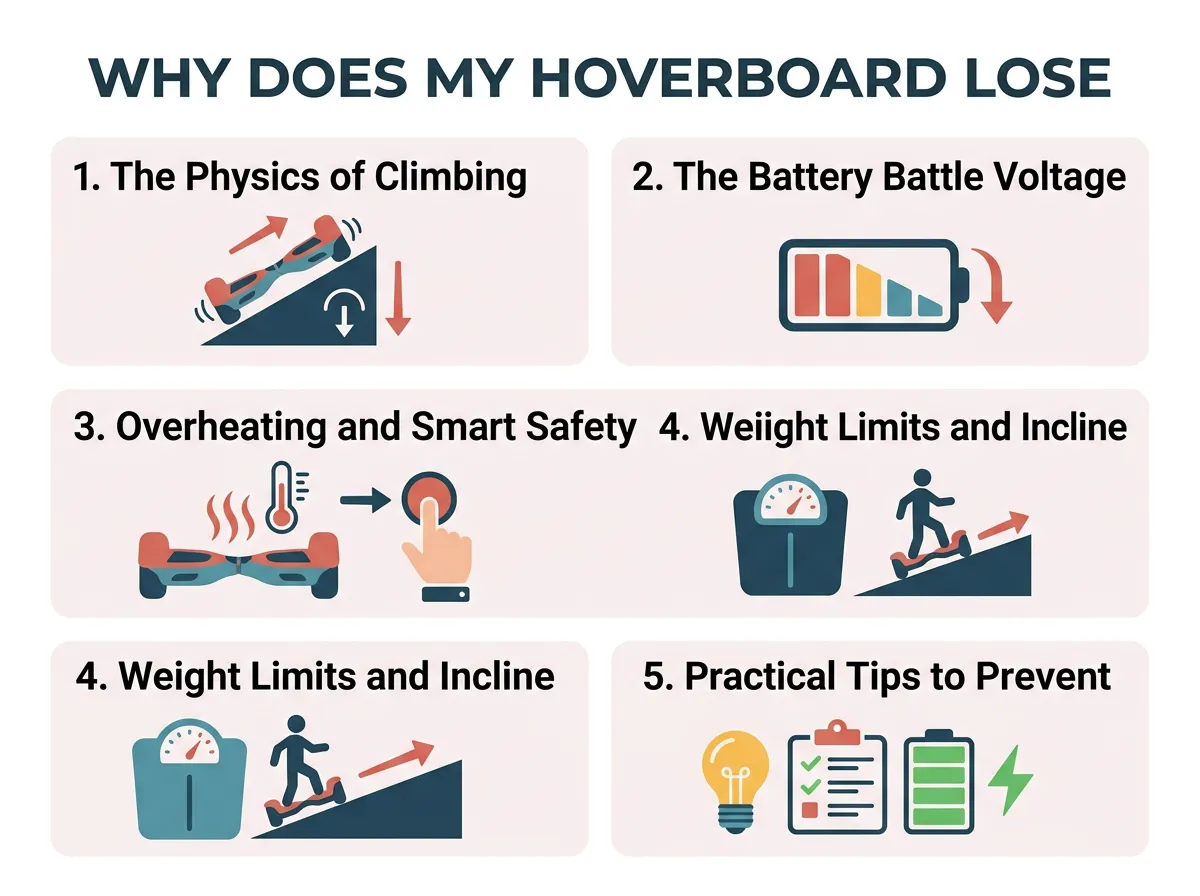
Why Does My Hoverboard Lose Power Going Uphill? — key points at a glance
Understanding Voltage Drop Under Load
Have you ever noticed your battery indicator drop when climbing a hill, only to rise again when you reach flat ground? This is called voltage sag. When your motors suddenly ask for a huge amount of current, the battery struggles to supply it all at once. The internal resistance of the battery causes its voltage to drop temporarily. Because speed is directly tied to voltage, this sudden drop makes your hoverboard lose power going uphill.
Battery Age and Health
If your hoverboard is a few years old, this problem will be even worse. Over time, lithium-ion batteries lose their ability to hold a charge. Their internal resistance goes up. An old battery might work fine on a flat park path, but it will quickly run out of breath on a steep driveway. If your board cuts out completely on small hills, your battery might be reaching the end of its life.
Overheating and Smart Safety Features
Hoverboards are smart devices. They have microchips and sensors that watch over the system. These sensors protect you from fires and prevent the board from breaking down.
Thermal Throttling to Prevent Damage
When electric motors and batteries work hard, they generate heat. Climbing a hill creates a lot of heat very quickly. If the temperature gets too high, the motherboard will step in. It will limit the power sent to the motors to help them cool down. This is called thermal throttling. It feels like a sudden loss of speed, but it is actually saving your board from melting its own wires.
Why Your Board Might Shut Off Completely
Sometimes, the safety system will go a step further. If the hill is too steep or you force the board too hard, it might beep and shut down entirely. This is a safety feature to prevent the circuit board from burning out. Some riders have experienced their board shutting down when leaning too far forward to force the board up a hill. Always listen to the warning beeps on your board. They are there to keep you safe.
Weight Limits and Incline Angles
Every hoverboard is built with specific limits in mind. These limits are usually listed in the user manual, but many riders ignore them. When you tackle hills, these limits become highly important.
The Impact of Rider Weight
Hoverboards have a maximum weight capacity, often between 160 and 220 pounds for standard models. If you are close to the weight limit, your board has to work much harder. On flat ground, you might not notice a difference. But on a hill, the extra weight combined with gravity can overload the motors. This will cause the board to lose power very quickly.
Exceeding the Maximum Slope Angle
Most budget hoverboards are designed for gentle slopes of 5 to 10 degrees. Premium models might handle up to 15 degrees. If you try to climb a hill that is steeper than your board’s rating, it will simply run out of power. You can read about the climbing capabilities of self-balancing boards to find out what angles are safe for your specific model. Trying to push past these limits can damage your hardware.
Practical Tips to Prevent Power Loss on Hills
You do not have to avoid hills forever. There are several things you can do to help your hoverboard climb better and stay strong.
Keep Your Battery Fully Charged
A battery that is at 100% charge has a much higher voltage than a battery at 50%. This extra voltage gives your board more headroom to fight voltage sag. If you know your route has hills, make sure to charge your board completely before you leave the house.
Take a Zig-Zag Approach
If you face a steep hill, do not ride straight up it. Instead, ride in a zig-zag pattern from side to side. This is called carving. Carving reduces the steepness of the angle you are climbing. It makes the hill longer, but it is much easier on your motors and battery.
Maintain Your Tires and Calibration
Make sure your tires are properly inflated if your hoverboard has pneumatic tires. Low tire pressure increases friction and makes your motor work harder. You should also calibrate your hoverboard regularly. A well-calibrated board can balance more efficiently, saving precious battery power for the climb.
Conclusion
In short, when you ask: “Why Does My Hoverboard Lose Power Going Uphill?”, the answer lies in physics, battery limits, and safety features. Your board is fighting gravity, which demands more torque and causes your battery voltage to sag. To protect itself from heat damage, your board may also slow down automatically.
By understanding your board’s limits, keeping your battery charged, and using smart riding techniques like carving, you can conquer hills with ease. Always listen to your board’s warnings, and do not force it beyond its limits. Happy riding, and enjoy the climb!
Frequently Asked Questions
Can all hoverboards go uphill?
Most hoverboards can handle gentle inclines between 5 and 15 degrees. However, budget models with smaller motors will struggle much more than premium off-road models designed for steep terrain.
Why does my hoverboard beep when I go uphill?
Your hoverboard beeps to warn you that it is reaching its physical limits. This can be due to overheating, a dangerously low battery, or a slope that is too steep for the motors to handle safely.
Does rider weight affect uphill speed?
Yes, rider weight has a huge impact on uphill performance. Heavier riders require the motors to use more torque, which drains the battery faster and causes the board to lose speed quickly on hills.
Is it bad to force my hoverboard up a steep hill?
Yes, forcing your board up a hill that is too steep can overheat the motors and motherboard. This can lead to permanent damage, melt internal wires, or cause the board to shut off suddenly, leading to a fall.
How can I make my hoverboard climb hills better?
You can improve climbing performance by keeping your battery fully charged, carving side-to-side instead of riding straight up, and ensuring your tires are properly inflated.
Will a low battery cause my hoverboard to stall on a hill?
Absolutely. A low battery has lower voltage, making it highly susceptible to voltage sag under load. This lack of electrical power will cause the hoverboard to stall or shut off on an incline.
